

Feeling more invested than your partner can be lonely. You may be the person who starts conversations, makes plans or asks where the relationship is going, while wondering whether the difference says something about their feelings.
You cannot reliably measure who loves whom more. You can look at the care, effort and agreements you are experiencing, explain what you need and decide whether the relationship works for you.
On this page
Describe the imbalance you notice
Start with examples rather than a conclusion about your partner’s heart. “I arranged our last three meetings” or “We have not discussed the change that affects both of us” gives you something concrete to raise.
People may express care differently or have unequal time, money and energy available. An uneven week does not tell you the whole story. What matters is whether both people can recognise needs, discuss limits and make a workable contribution.
Notice the effect on you as well. Do you feel uncertain, overburdened or unable to ask for anything? You do not need to establish a hidden motive before taking that experience seriously.
Check what each of you expects
You may be imagining different relationships. One person may want regular time together or a shared future while the other wants something more casual. Affection alone does not establish that you have made the same agreement.
Ask directly: “What do you want this relationship to include?” Discuss the areas that matter to you, such as exclusivity, contact, shared responsibilities or future plans. Leave room for an honest answer rather than an answer designed to reassure you.
Independent decisions and interests can exist within a caring partnership. For choices that affect both of you, consider how each person gets a voice and how commitments are made.
Ask for a specific change
Choose one concern and explain the request behind it. “I would like you to suggest our next plan” is easier to discuss than “Prove you care as much as I do.” You might also ask for a conversation about an agreement that has become unclear.
Try: “I enjoy being with you, but I feel unsure when I am always the one arranging time together. Would you be willing to plan something that works for both of us?”
Your partner can have limits or a different preference. Listen to what is possible, but do not treat a vague promise as a settled agreement. Clarify what each of you is actually choosing.
Look for shared effort over time
After the conversation, notice whether the agreed change happens. Does your partner follow through, discuss difficulties or help revise a plan? A relationship cannot be maintained by one person’s increasing effort alone.
Spending time with friends or keeping personal interests does not automatically mean a partner values you less. Avoid turning care into a competition for all of their time. Instead, ask whether your shared time and responsibilities receive the attention you have agreed on.
There is also a difference between disappointment and being mistreated. Insults, threats or pressure around your boundaries deserve attention regardless of how much love someone says they feel. Seek suitable support if you feel afraid or controlled.
Decide what you can accept
You may choose another conversation, a different arrangement or an end to the relationship. Base that choice on the pattern you see and what you need, rather than waiting for a perfect explanation of the other person’s feelings.
If you want different things, neither person has to become more persuasive or more devoted to make the mismatch disappear. You can care about someone while recognising that the relationship available to you is not the one you want.
Read the infographic in text
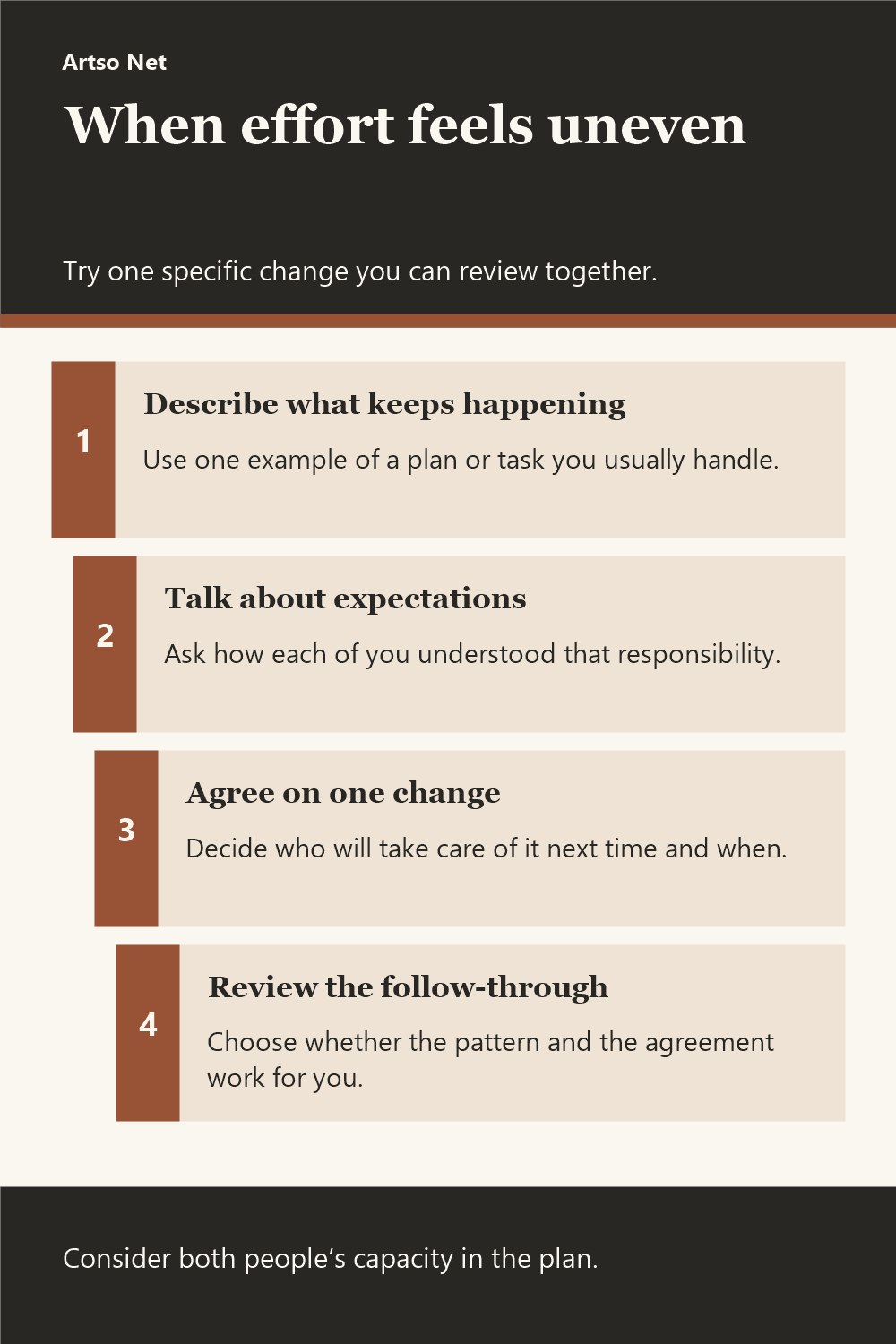
When effort feels uneven Try one specific change you can review together.
- Describe what keeps happening Use one example of a plan or task you usually handle.
- Talk about expectations Ask how each of you understood that responsibility.
- Agree on one change Decide who will take care of it next time and when.
- Review the follow-through Choose whether the pattern and the agreement work for you.
Consider both people’s capacity in the plan.