

You may enjoy spending time with someone and still be unsure whether you want the same kind of relationship. A missed social post, a private friendship or a preference about overnight visits cannot answer that question on its own.
Look at what has been said, what has been agreed and how you are treated. You can ask for clarity without proving that the other person is hiding something or persuading them to want commitment.
On this page
1. Start with the agreement you have
Ask whether you have actually discussed dating intentions, exclusivity or a shared label. Spending time together can mean different things to different people. Neither person should have to infer a commitment from affection or the number of dates.
You might say, “I have enjoyed getting to know you, and I am looking for a relationship. What are you hoping for?” Choose a time when both people can answer freely, rather than presenting the question as a test they must pass.
A different answer may be disappointing without being dishonest. If someone says they want casual dating, consider whether that fits you instead of assuming they will change once they know you better.
2. Use nine conversation questions
Choose the questions that matter now. You do not need to discuss every topic at once.
- What kind of connection are we each looking for?
- Have we agreed to exclusivity, or are we still seeing other people?
- What does a relationship label mean to each of us?
- What amount and kind of contact feels workable?
- How do we make or change plans?
- What would we like to keep private, including online?
- When would meeting friends or family feel comfortable and safe?
- What limits do we each have around visits, intimacy and personal time?
- If our wishes change, how will we tell each other?
Listen to the answer rather than selecting only the parts you hoped to hear. You can ask for clarification if a word such as “serious” means something different to each person.
3. Keep privacy and choice in view
Someone may avoid public posts for work, family, safety or personal reasons. Keeping a relationship off social media is different from lying about an agreement. Discuss the actual concern without requiring public proof or access to private messages.
Contact with an ex is not automatically evidence of cheating; shared children or ordinary friendship may be involved. Talk about specific conduct and the agreements you both choose. A rule that isolates someone from every friend is a different matter.
People can also have limits about overnight visits or being cared for when ill. Those preferences deserve a conversation. There is no required number of nights together that proves love, and physical intimacy remains optional regardless of commitment.
The love is respect guide to boundaries explains personal and digital limits and the difference between protecting your needs and controlling someone else.
4. Compare answers with follow-through
Consider whether plans become definite, changes are communicated and agreed limits are respected. A single disruption may need an explanation or a new arrangement. Repeated broken agreements give you a practical pattern to discuss.
Use an example: “We have cancelled three planned evenings without arranging another. Is regular dating something you can offer?” This is more useful than deciding that one gender always pursues the person they want.
You do not need expensive gifts or constant access to feel valued. When Effort Feels Uneven: Needs, Agreements and Mutual Care offers further questions about shared effort.
5. Decide what works for you
You can decide that the arrangement does not meet your needs even when neither person is wrong. Name your choice clearly rather than using distance or jealousy to try to produce commitment.
If asking ordinary questions leads to threats, humiliation or fear, seek individual support and consider safety before another confrontation. High-Conflict Patterns in a Relationship: Behaviour, Boundaries and Safety offers related reading.
A useful answer may be yes, no or “I cannot offer that.” Clarity gives you something to decide from; it does not require you to stay until both people want the same future.
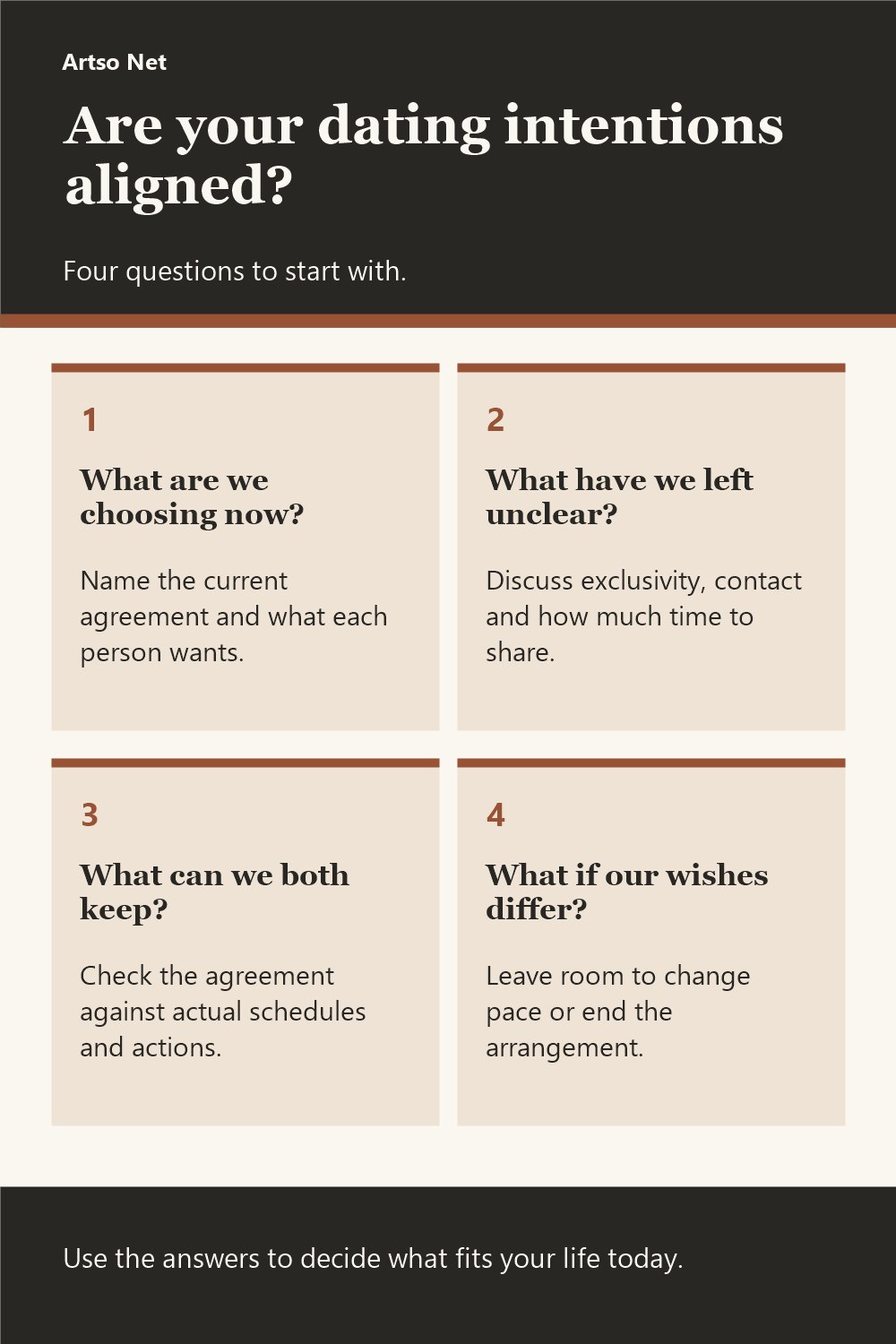
Read the infographic in text
Are your dating intentions aligned? Four questions to start with.
- What are we choosing now? Name the current agreement and what each person wants.
- What have we left unclear? Discuss exclusivity, contact and how much time to share.
- What can we both keep? Check the agreement against actual schedules and actions.
- What if our wishes differ? Leave room to change pace or end the arrangement.
Use the answers to decide what fits your life today.