

A partner can have worries, preferences and boundaries without being entitled to direct your life. Controlling behaviour becomes a concern when pressure, monitoring, threats or restrictions reduce your freedom to make your own choices.
You do not have to diagnose a partner, prove their motives or wait for physical violence before seeking support. If you are in immediate danger, contact local emergency services when it is safe to do so. If you fear a partner’s response, prioritise confidential advice over confronting them alone.
Notice demands for access and permission
Consider what happens when you make an ordinary choice: seeing a friend, wearing something you like or spending time alone. Can you discuss plans as an equal, or are you expected to obtain permission and justify yourself repeatedly?
Demands to read messages, share passwords or provide constant location updates can limit privacy. An agreement is not freely chosen if refusing or changing it leads to threats or punishment.
Concern about your wellbeing can be expressed without taking over your decisions. The important question is what your partner does and how freely you can respond.
Look at isolation and repeated humiliation
A partner may discourage friendships, make seeing family difficult or create consequences whenever you spend time with other people. Isolation can also involve interfering with work, study or access to transport.
Repeated insults, public humiliation and claims that you cannot do anything right deserve attention. Disagreeing about a particular decision is different from undermining your ability to make decisions at all.
The National Domestic Violence Hotline includes isolation, humiliation and restrictions on decisions among its warning signs of abuse. You can seek advice about a behaviour even if you are uncertain what label fits the relationship.
The related guide to recognising manipulation and considering boundaries safely gives further examples without requiring you to guess another person’s motives.
Take threats and intimidation seriously
Threats may involve you, children, pets, belongings, housing or information a partner knows about you. Blocking an exit, damaging property or making you afraid to disagree is not an ordinary communication problem.
You may comply, stay quiet or change plans because it feels like the safest available response. That does not make you weak or responsible for the other person’s behaviour.
You do not have to test how serious a threat is by challenging it. Seek help with a plan that fits your situation, especially if you are considering leaving or changing contact.
Consider control over money, work and intimacy
Notice whether you can access resources you need and participate in decisions affecting your life. A partner might take money, obstruct employment or make you account for every purchase while withholding their own information.
Consent also matters within an established relationship. A relationship, a date or financial support does not create an entitlement to sex, affection or access to your body.
Practical dependence can make choices harder. You can ask a specialist service about available support without having a complete plan or deciding immediately whether to end the relationship.
Seek support through a safer channel
If you suspect your device or accounts are monitored, consider using a safer device or asking a trusted person or specialist service about digital safety. Get advice about account changes and how to contact support more privately.
In the United States, the National Domestic Violence Hotline offers safety-planning resources and ways to reach an advocate. Elsewhere, a local domestic abuse service may help you explore options. Availability and services differ by location.
If it is safe, tell someone you trust what is happening and what help you would find useful. That could mean a place to talk, transport, help locating a service or a practical check-in. Avoid making a record on a device your partner can access if that could increase risk.
Make decisions without owing a confrontation
You may choose to gather information, make a practical plan, reduce contact or leave. A safer next step depends on your circumstances, including housing, finances, children and the behaviour you are facing.
You do not owe someone a private meeting, a detailed explanation of your plans or another chance to demonstrate that you care. Seek individual specialist advice before arranging a joint conversation or counselling when there is fear or coercion.
If you remain uncertain, describe the specific behaviour to an advocate rather than trying to present a perfect case. You deserve support with your choices, and responsibility for controlling or abusive actions belongs to the person taking those actions.
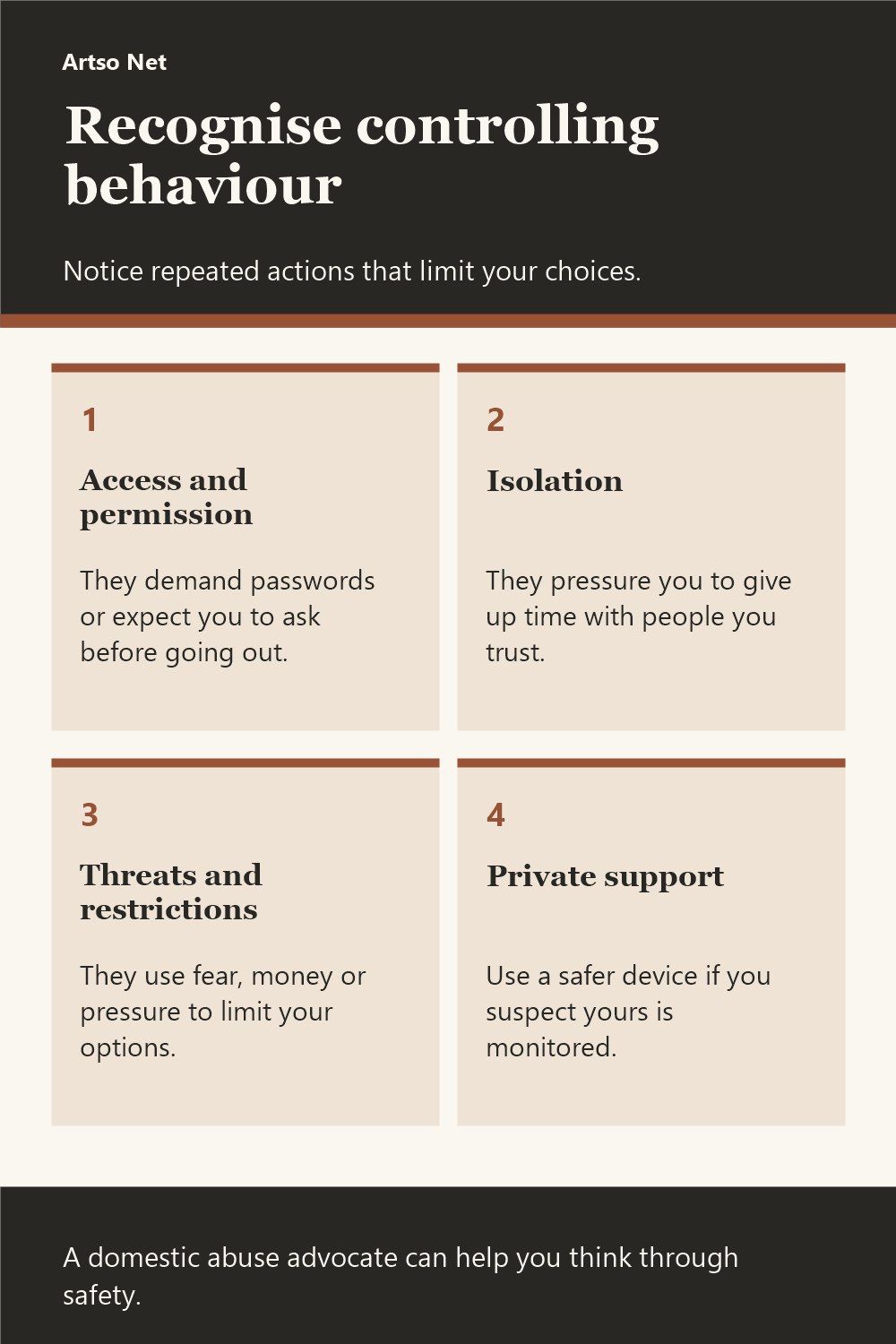
Read the infographic in text
Recognise controlling behaviour Notice repeated actions that limit your choices.
- Access and permission They demand passwords or expect you to ask before going out.
- Isolation They pressure you to give up time with people you trust.
- Threats and restrictions They use fear, money or pressure to limit your options.
- Private support Use a safer device if you suspect yours is monitored.
A domestic abuse advocate can help you think through safety.