

If you organise every meeting, start every conversation or keep raising questions that go unanswered, you may wonder whether you are trying to sustain the relationship alone. That feeling deserves attention without requiring you to guess exactly what another person thinks.
People contribute in different ways, and equal care does not mean identical tasks or a fixed number of daily messages. Look at the pattern, its effect on you and whether both people are willing to discuss a workable change.

Describe the planning pattern clearly
Replace “I do everything” with a few concrete examples. Perhaps you suggested the last several meetings, arranged transport or followed up each time plans were unclear.
Consider work, health, caring responsibilities and any arrangement you have already made. Those circumstances may explain a difference in tasks without making your own needs disappear.
Ask for something specific: “I would like you to suggest our next date and confirm the details.” You do not need to stop communicating secretly to see whether the other person passes a test.
Ask about feelings without demanding a performance
It is reasonable to want clarity about the relationship. You can say what you feel and ask what the other person wants, while allowing an honest answer that may differ from your hopes.
Some people express affection more easily through actions than words. That does not mean you must accept indefinite uncertainty about whether you are dating or what has been agreed.
If you repeatedly seek reassurance, consider what remains unresolved. A clear question about commitment or behaviour may be more useful than asking for the same reassurance while the situation stays unchanged.
Talk about a future that matters to each of you
You may want to discuss exclusivity, living arrangements, marriage, children or another shared plan. Neither person has to want every conventional relationship milestone.
Ask whether your wishes are compatible and what each of you can realistically say now. Someone may need time to think; agree when you will return to a question if you both want to.
Repeatedly avoiding a subject that affects your choices can leave the relationship unsuitable for you. It does not let you read the other person’s mind, but it does give you information about what is currently available.
Notice whether concerns receive a respectful response
A joke may be an awkward response rather than a complete statement of someone’s intentions. Explain when you need a serious conversation: “I know this is uncomfortable, but I need us to talk about it.”
Look at what happens next. Can they listen, ask a question or acknowledge the effect on you? Or do your concerns consistently become something you are mocked or punished for raising?
You do not need a perfect conversation. You do need room to describe a concern without being belittled. If you fear retaliation, seek individual support rather than trying to find a more persuasive way to confront the person.
Agree a communication rhythm that fits real life
There is no universal requirement to call several times a day. Discuss what contact feels meaningful and manageable for each of you, including practical expectations around plans and changed arrangements.
You might say, “I enjoy hearing from you, and I would like us both to initiate contact. What would work for you?” Listen for an agreement they genuinely want and can keep.
A late reply alone does not establish a lack of care. A continuing mismatch that leaves you unhappy can still matter. You are allowed to choose a relationship with a rhythm that suits you.
Use the response to make your own choice
Disagreement is not automatically rejection. Both people can have preferences and say no. Notice whether your views receive consideration and whether decisions affecting both of you are made together.
After a clear conversation, look for follow-through rather than a promise designed to end the discussion. You can revisit an agreement and decide what you will do if the same pattern continues.
You might continue with a different arrangement, seek support or end the relationship. A boundary describes your own choice; it is not a technique for making someone become more attached. You do not need to keep pursuing a relationship that cannot offer what you want.
Read the infographic in text
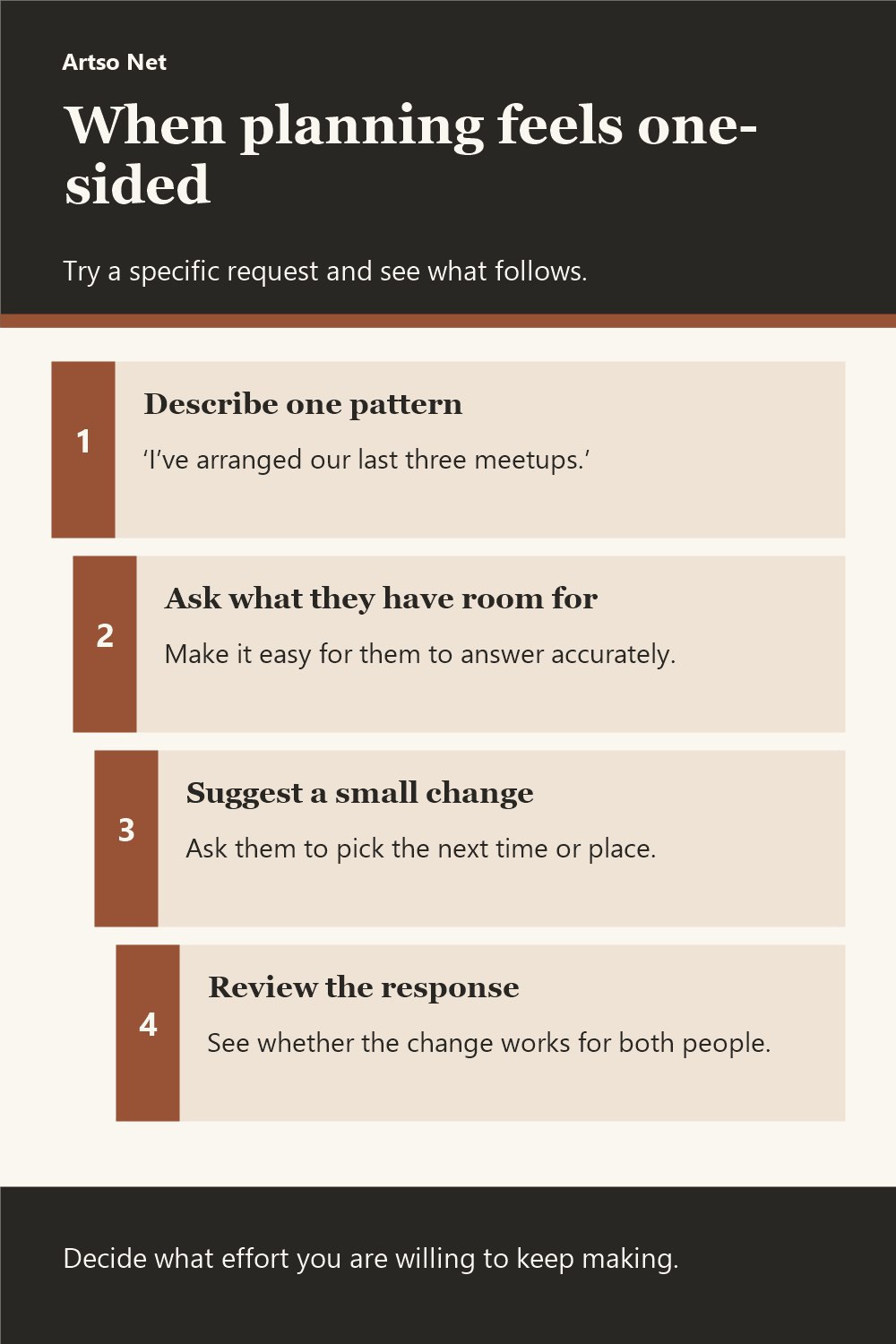
When planning feels one-sided Try a specific request and see what follows.
- Describe one pattern ‘I’ve arranged our last three meetups.’
- Ask what they have room for Make it easy for them to answer accurately.
- Suggest a small change Ask them to pick the next time or place.
- Review the response See whether the change works for both people.
Decide what effort you are willing to keep making.