

If you want to date a man who treats you well, “a good man” is a starting idea rather than a complete description. Think about the relationship you want: how you would spend time together, discuss differences and respect each other’s choices. Attraction matters, but so does whether the connection fits both people’s lives.
You do not need to become perfect, follow strict dating rules or disclose everything immediately to deserve respect. You can be clear about your needs while getting to know someone gradually. Another person remains responsible for their own behaviour.
On this page
1. Describe the qualities you want in everyday terms
Words such as kind, reliable or mature can mean different things. Turn each one into something you could discuss or observe. Reliability might mean keeping plans or telling you when they change. Kindness might include listening without mocking you and treating other people considerately.
Consider the life you would actually share. Do you want frequent time together, separate homes, children, a particular relationship structure or room for substantial caring responsibilities? Neither a successful career nor a shared hobby answers all of these questions.
Choose a few matters that are important to you now, leaving room to learn. A list can guide a conversation; it cannot certify someone’s character or guarantee a relationship. You may meet a considerate person whose plans simply do not match yours.
2. Separate preferences, needs and boundaries
A preference could be enjoying the same kind of weekend. A need might be enough predictable time together to make the relationship workable. A boundary describes what you will participate in, such as declining sexual activity you do not want. These can overlap, and you can reconsider them as your circumstances change.
Being flexible about a restaurant does not mean agreeing to unwanted touch. Equally, a different taste in music does not establish a lack of respect. Discuss the actual issue instead of treating all compromise as a danger or all differences as something you must accept.
For example: “I prefer to make plans ahead. Are you comfortable choosing a day now?” gives the person a question they can answer. If their preferred arrangement repeatedly leaves you without the time you need, you can decide it does not fit.
Difficulty holding a boundary does not make mistreatment your fault. You do not need flawless confidence or the right wording before someone owes you respectful behaviour.
3. Choose opportunities that suit your life
Think about ways to meet people that you would find manageable: an introduction through friends, a regular interest group, a community activity or a dating app. None is a guaranteed route to a particular kind of partner.
Choose according to your time, comfort and interest. A class can be worthwhile because you enjoy the subject even if you never meet a date there. When someone is simply participating in a shared activity, leave them free to keep that connection non-romantic.
If you use an app, describe the kind of connection you are seeking without promising more than you currently want to offer. You can limit the time you spend browsing and pause when it stops feeling useful.
If a friendship becomes the starting point, Thinking About Dating a Friend explores how to make an invitation without making friendship conditional on a yes. Familiarity does not establish romantic interest.
4. Ask clearly and leave room for an honest answer
You do not have to interview someone about every major life decision on a first date. Begin with what affects the next step: whether you are both interested, what kind of dating you want and what pace feels comfortable.
Try a question such as, “I am interested in a relationship if the connection develops. What are you hoping for?” Listen to the answer being offered rather than the one you might eventually persuade them to give.
Honesty does not mean immediate access to your passwords, finances, health history or past experiences. You can say, “I am not ready to talk about that.” Share information at a pace you freely choose, while being clear about agreements that affect the relationship.
The NHS guidance on healthy relationships discusses open communication, listening and boundaries. A useful conversation makes room for both people to speak; it does not require identical preferences or a particular outcome.
5. Notice behaviour without setting tests
Consider how ordinary situations unfold. Can you decline a plan, ask for clarification or say you prefer a slower pace? Does the person follow an agreement, acknowledge a mistake and leave room for your choices?
There is no need to create jealousy, deliberately delay replies or invent a problem to measure their interest. Those tactics add uncertainty. Asking directly and noticing actual behaviour can give you more relevant information.
A late arrival deserves context: was there an unexpected problem, did they let you know, and is this happening repeatedly? You can express frustration without declaring that one delay proves someone is bad. You can also decide that a continuing pattern is more than you want to accommodate.
Threats, intimidation, sexual pressure or efforts to isolate you call for a different response from an ordinary scheduling difference. You do not need to keep dating someone to collect more evidence. Seek individual support if you feel unsafe, and prioritise safety over arranging a final private conversation.
6. Review whether you both want to continue
After time together, ask what you actually learned. Did you enjoy the company? Could you express a preference? Are your intentions compatible? Are you interested in another meeting, or mainly worried about disappointing the person?
You can want another date without knowing whether this will become a long-term partnership. You can also decline without identifying a serious fault: “Thank you for meeting me. I do not want to continue dating.” A considerate response leaves room for that choice in either direction.
Keep friendships, interests and ordinary support available as you date. Showing up as yourself includes being allowed to learn, change your mind and keep parts of life private. You do not have to mirror every quality you seek in order to deserve it from another person.
Finding a suitable partner depends on mutual interest and the relationship you both choose to build. For now, aim for a clear, manageable next step rather than a method that promises to prevent every disappointment.
Read the infographic in text
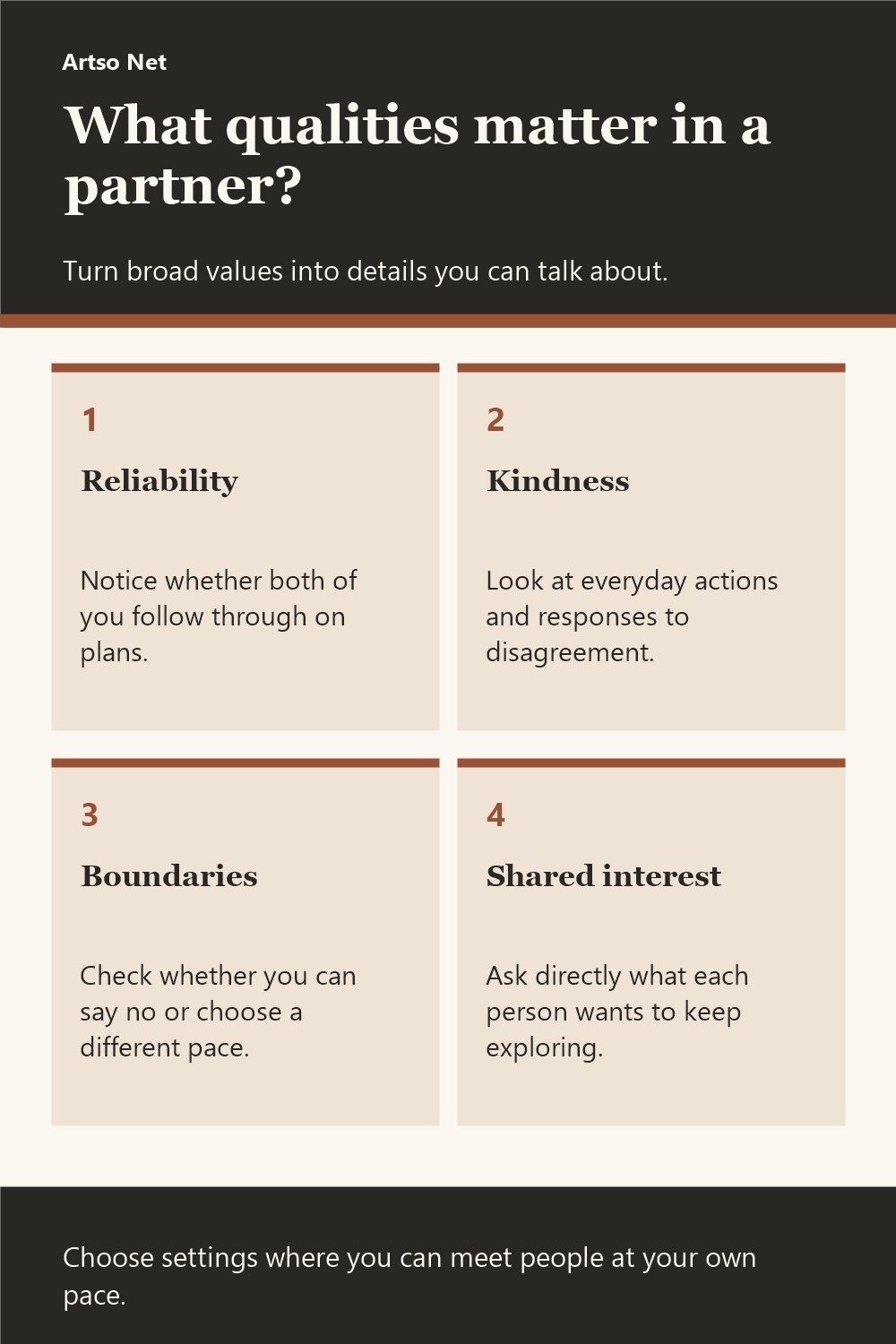
What qualities matter in a partner? Turn broad values into details you can talk about.
- Reliability Notice whether both of you follow through on plans.
- Kindness Look at everyday actions and responses to disagreement.
- Boundaries Check whether you can say no or choose a different pace.
- Shared interest Ask directly what each person wants to keep exploring.
Choose settings where you can meet people at your own pace.