

After a relationship ends, people sometimes say that the pain will lead you to a greater love. That may be meant kindly, but nobody can promise what comes next. You do not have to turn heartbreak into a lesson, feel grateful for it or begin dating to show that you are recovering.
Rebuilding can mean having a steadier day, reconnecting with someone you trust or making a decision that belongs to you. Those changes matter whether your future includes a new relationship, time alone or a different kind of life from the one you expected.
Name what has changed without predicting your future
You may be missing a person, shared routines, mutual friends or plans you had begun to treat as certain. Naming the particular loss can make your next step clearer. Missing an evening conversation might call for company; practical disruption might call for a plan for meals, transport or household tasks.
Try keeping “what happened” separate from “what it must mean about me.” A relationship ending does not establish that you are unlovable or that every future relationship will end the same way. You also do not need to decide today whether it was the best or worst thing that ever happened to you.
Build a manageable daily rhythm
Start with a few ordinary anchors: a meal, a walk or other movement that suits you, a task you need to finish and a chance to rest. Choose a scale that fits your current energy. A short errand can be enough for a difficult afternoon.
If certain reminders repeatedly interrupt your day, change what is easy to change. Put keepsakes somewhere you do not see constantly, adjust a playlist or mute updates you keep checking. These are practical choices, not a requirement to erase a shared history.
A simple plan for tomorrow can help: one necessary task, one connection with another person and one thing you would like to do. Leave space for days when you do less.
Reflect without making yourself the whole problem
When you feel ready, consider what worked, what hurt and what you would want to approach differently. You might write three short notes: what you observed, how it affected you and what you would ask for in a future relationship.
For example, “Plans were cancelled at short notice; I often felt unable to rely on them; I want us to communicate changes and make realistic arrangements.” That is more useful than deciding that you must become easier to love.
You can take responsibility for your own choices without accepting responsibility for another person’s deception, cruelty or controlling behaviour. Growth is an option you can pursue, not proof that the hurt was necessary.
Reconnect with people and interests outside the relationship
Consider which parts of your life became smaller. A friend, hobby, community group or familiar place may offer a way back into ordinary enjoyment. You do not have to feel cheerful before taking part, and an activity does not need to transform your life to be worthwhile.
Tell trusted people what would help. You might want company for dinner, help with a practical task or a conversation that does not focus on your former partner. If someone’s advice leaves you feeling judged, you can ask for a different kind of support.
A new relationship need not be the centre of your recovery. Friendship, independence, creativity and a more comfortable home life can each be meaningful goals.
Let dating be a choice rather than a recovery test
There is no universal waiting period after heartbreak. Instead, ask what you want from dating now and what you can honestly offer. Are you curious about meeting a person, or mainly hoping a new connection will reassure your former partner or silence difficult feelings?
You do not have to be perfectly confident to date. You can choose a slower pace, keep early meetings simple and communicate your intentions. Pay attention to consistent behaviour rather than treating intense chemistry or immediate ease as evidence that this person is destined for you.
You can also pause. Enjoying time alone is not a failure to move forward, and a difficult day does not cancel the progress you have made.
Review what helps and ask for support when needed
After a little time, notice which choices make daily life more manageable. Perhaps less social-media checking helps, or company matters more than you expected. Keep what works and change a plan that is making things harder. Recovery can be uneven without being meaningless.
If distress is making it hard to manage everyday life, consider talking with a qualified professional. The NHS guidance on relationships and mental wellbeing includes further ideas for communication, boundaries and getting support.
You do not need a prediction about your next love story to care for yourself now. A life with more room for your own needs and choices is a worthwhile direction in itself.
Read the infographic in text
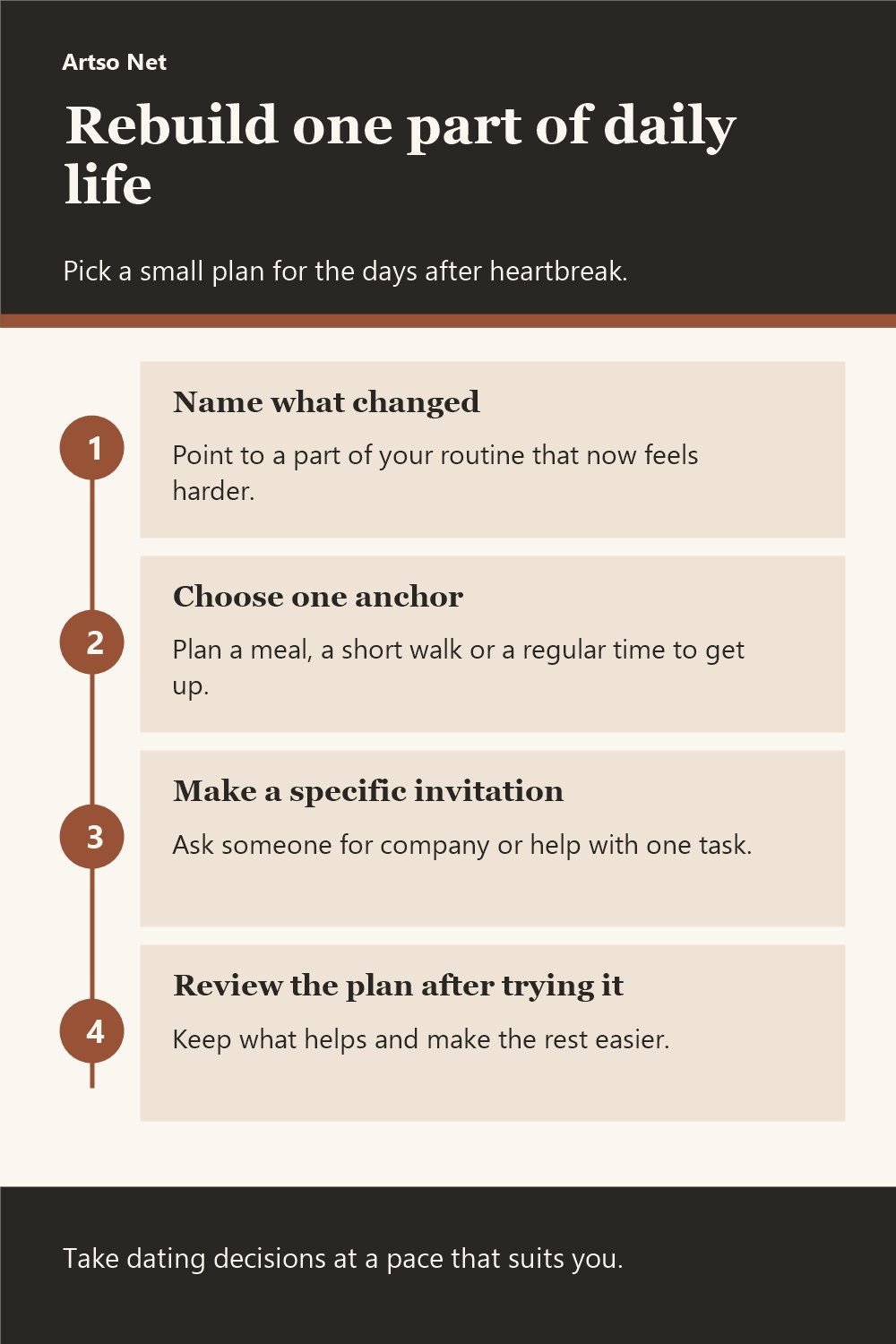
Rebuild one part of daily life Pick a small plan for the days after heartbreak.
- Name what changed Point to a part of your routine that now feels harder.
- Choose one anchor Plan a meal, a short walk or a regular time to get up.
- Make a specific invitation Ask someone for company or help with one task.
- Review the plan after trying it Keep what helps and make the rest easier.
Take dating decisions at a pace that suits you.