

Meeting the family, exchanging thoughtful gifts or talking about a holiday can feel significant. Those gestures do not tell you whether your partner wants marriage, wants it with you or has the same timing in mind.
If marriage matters to you, discussing it is a reasonable part of understanding your relationship. You can ask openly without demanding a proposal. The aim is to learn what each of you wants and whether your plans can work together.
Start with what marriage means to each of you
Marriage may represent family, faith, commitment, security or a shared tradition. Someone else may want a lasting partnership without marrying. Neither person’s meaning should be assumed from their age, gender, family background or enjoyment of weddings.
Ask: “Do you see marriage as something you want in your life?” Then distinguish that general preference from the relationship you share: “Is it something you would want us to consider together?” An enthusiastic view of marriage in general is not the same as a mutual plan.
Explain why it matters to you in your own words. You do not need to make your wishes sound smaller to keep the conversation comfortable.
Choose a conversation rather than a test
Find a calm time when neither person is rushing. You might begin: “I care about our relationship, and I would like to talk about whether we want marriage and what timing feels realistic.” If the topic is unexpected, agree a time to return to it.
Avoid using ring hints, jealousy, family pressure or withdrawal of affection to find out what they think. Direct questions give both people a clearer opportunity to respond. The Centre for Clinical Interventions’ assertiveness resources offer practical ways to communicate your needs while respecting another person’s choices.
You can listen carefully and still disagree. A difficult answer is useful information, even when it is not the answer you hoped for.
Make timing and readiness specific
“Someday” can mean very different things. Ask what being ready would look like: more time together, a change in living arrangements, completing a course or discussing unresolved concerns. Listen for a specific explanation rather than trying to infer a timeline from gifts or family approval.
If both of you want time to think, agree when you will talk again and what each person will consider beforehand. A review date is an opportunity for an honest conversation, not an automatic engagement deadline.
You can also decide how long uncertainty is workable for you. State that as your own decision about your life, rather than a punishment designed to force a yes.
Discuss the ordinary life beyond a wedding
A proposal is only one moment. Useful conversations include whether you want children, where you would live, how you handle money and household work, and what support or privacy each person needs. Make space for faith, family involvement, careers and caring responsibilities where they matter to you.
- What would a fair division of everyday work look like?
- Which decisions would we make together, and which remain individual?
- What happens when our plans, incomes or needs change?
- Which differences are workable, and which might prevent the life either of us wants?
You do not need perfect answers in one evening. Notice whether both people can discuss these subjects honestly and follow through on agreed next steps.
Take different answers seriously
One person may want marriage soon while the other does not want it at all. That difference is not solved by proving how much you love each other. Explore whether there is room for a freely chosen agreement, without assuming that patience or effort will change someone’s fundamental wishes.
“I do not know” may be honest. You can ask what remains uncertain and whether they want to work through it together. Repeatedly avoiding the discussion also gives you information about what is currently possible.
You may choose to continue, seek support for the conversation or leave a relationship that cannot meet an important need. A choice can be painful without either person being a failure.
Notice how the conversation is handled
Disagreement about marriage can be respectful. You should be able to express a wish, ask a question or decline a plan without threats, humiliation or pressure. An engagement does not resolve controlling behaviour or make a relationship safe.
If raising the subject could put you at risk, prioritise support rather than arranging a private confrontation. The National Domestic Violence Hotline’s guide to healthy relationships describes respect, boundaries and equality.
Finish a constructive conversation by naming what you understand, what remains open and any next step you both choose. A shared answer is more useful than collecting signs that a ring might be coming.
Read the infographic in text
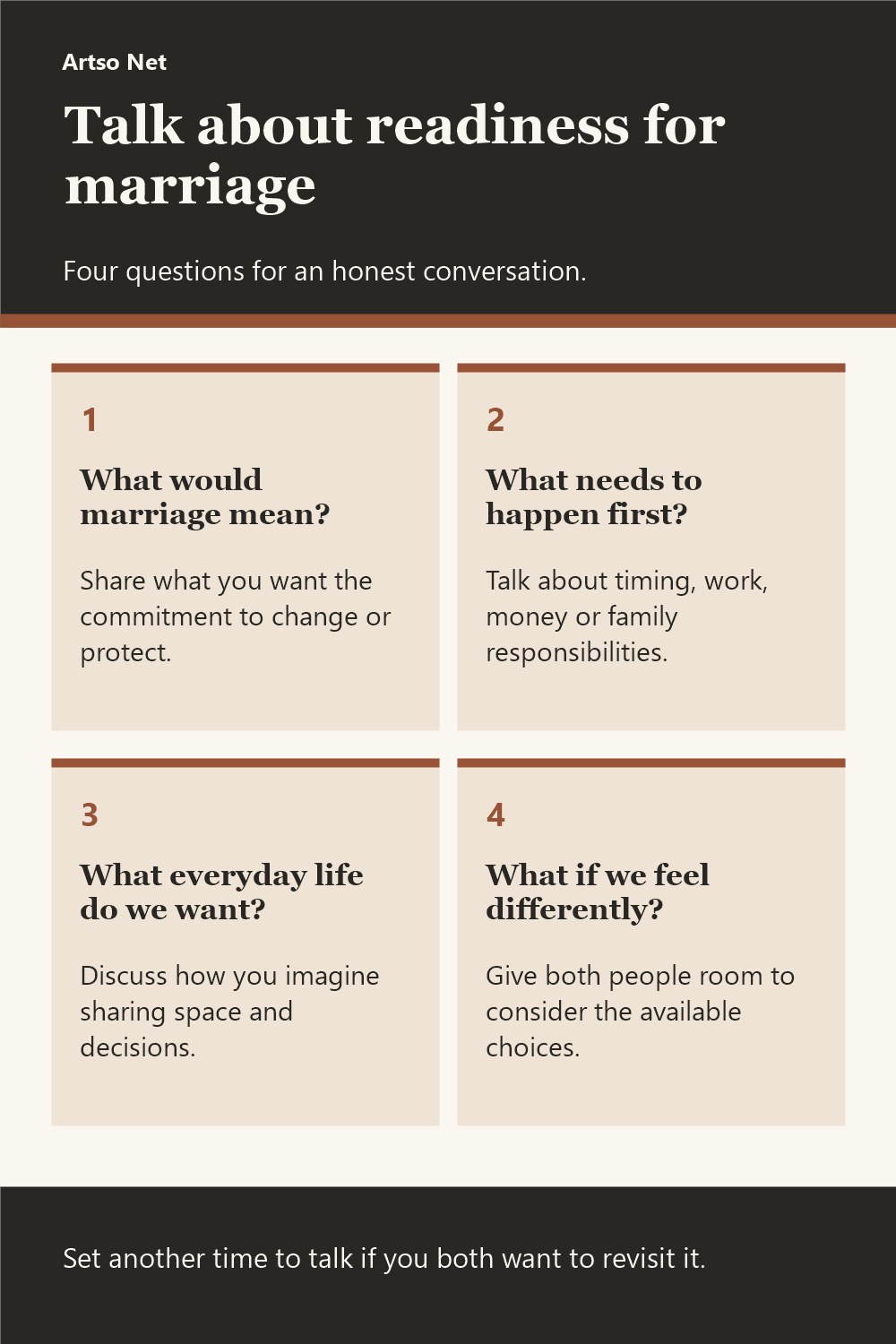
Talk about readiness for marriage Four questions for an honest conversation.
- What would marriage mean? Share what you want the commitment to change or protect.
- What needs to happen first? Talk about timing, work, money or family responsibilities.
- What everyday life do we want? Discuss how you imagine sharing space and decisions.
- What if we feel differently? Give both people room to consider the available choices.
Set another time to talk if you both want to revisit it.