

You can love someone and still need a clearer conversation about marriage. Wanting to know whether you share that goal is reasonable; it does not require guessing what an introduction, a family comment or an affectionate weekend means.
Start with your own wishes and invite an honest answer. A useful conversation leaves both people free to say what they want, including when the answers are different. You can then decide what those differences mean for your next step.
Be clear about what marriage means to you
Consider which parts matter: a shared commitment, a public celebration, family recognition, religious meaning or the practical arrangements of a life together. Your reasons may include several of these.
You do not need to dismiss your wish for marriage as “just wanting a wedding.” Nor does someone who does not want marriage automatically care less about a partner. The question is whether the future each person wants can work for both.
Separate your preference from pressure from relatives, friends or a deadline you have never chosen for yourself. That can help you explain your position without making the other person responsible for every outside expectation.
Ask directly about the future
Choose a time when you can talk without rushing and ask whether it is a good moment. You might say, “Marriage is something I want in my future. Is that a possibility you want to explore with me?”
A hypothetical question about life in five years can open a discussion, but it should not become a hidden test. Be willing to name marriage if that is what you need to understand.
Listen to the answer as it is given. Wanting children, sharing a home and wanting marriage are separate questions. None should be assumed from the others, and people can choose a meaningful life without any of them.
Discuss the relationship you are actually choosing
Before making major plans, clarify your current agreements. Are you both choosing a committed relationship? What does exclusivity mean to each of you, if you want it? How do you make decisions that affect you both?
Then talk about practical areas such as money habits, home responsibilities, children or being child-free, family involvement and where you would like to live. You do not have to settle everything in one evening.
Notice how the discussion works as well as what is said. Can you disagree, ask for time and return to a subject without threats, ridicule or pressure to accept a decision already made for you?

Distinguish a practical obstacle from an unclear answer
Someone may want marriage and still have a practical concern about costs, housing, family circumstances or timing. Ask what the concern is and whether there is a realistic next step you both want to take.
“We want to discuss a small celebration after we review our budget” gives you something different to consider from “Maybe someday” repeated without a conversation. Neither answer obliges you to wait indefinitely.
There is no universal number of months or years that establishes readiness. Look at what you know about each other, whether your goals fit and whether you can make informed, unpressured choices.
Agree when to revisit uncertainty
If one person is unsure, you can agree a reasonable time to return to the conversation. Be specific about what you are considering in the meantime, such as a financial question or an important difference about children.
An agreed check-in is not a promise to propose. It is a way to avoid leaving a major question permanently unspoken. You can also say what continuing in uncertainty would mean for your own decisions.
Avoid treating patience as a way to earn marriage or a deadline as a way to force consent. Both people can make their position clear, and both retain the right to choose.
Make room for a decision that fits your life
You may find a shared goal, decide that you want more time or recognise that your wishes are incompatible. A loving connection can be real while a major difference still matters.
If you choose to keep working on the relationship, focus on the specific question that remains. Qualified relationship support may help with a difficult discussion when both people feel safe and want to participate; it cannot decide your preferred future for you.
If the relationship involves intimidation or control, consider individual support before raising plans that could put you at risk. You can value the relationship and still protect your freedom to decide whether to stay.
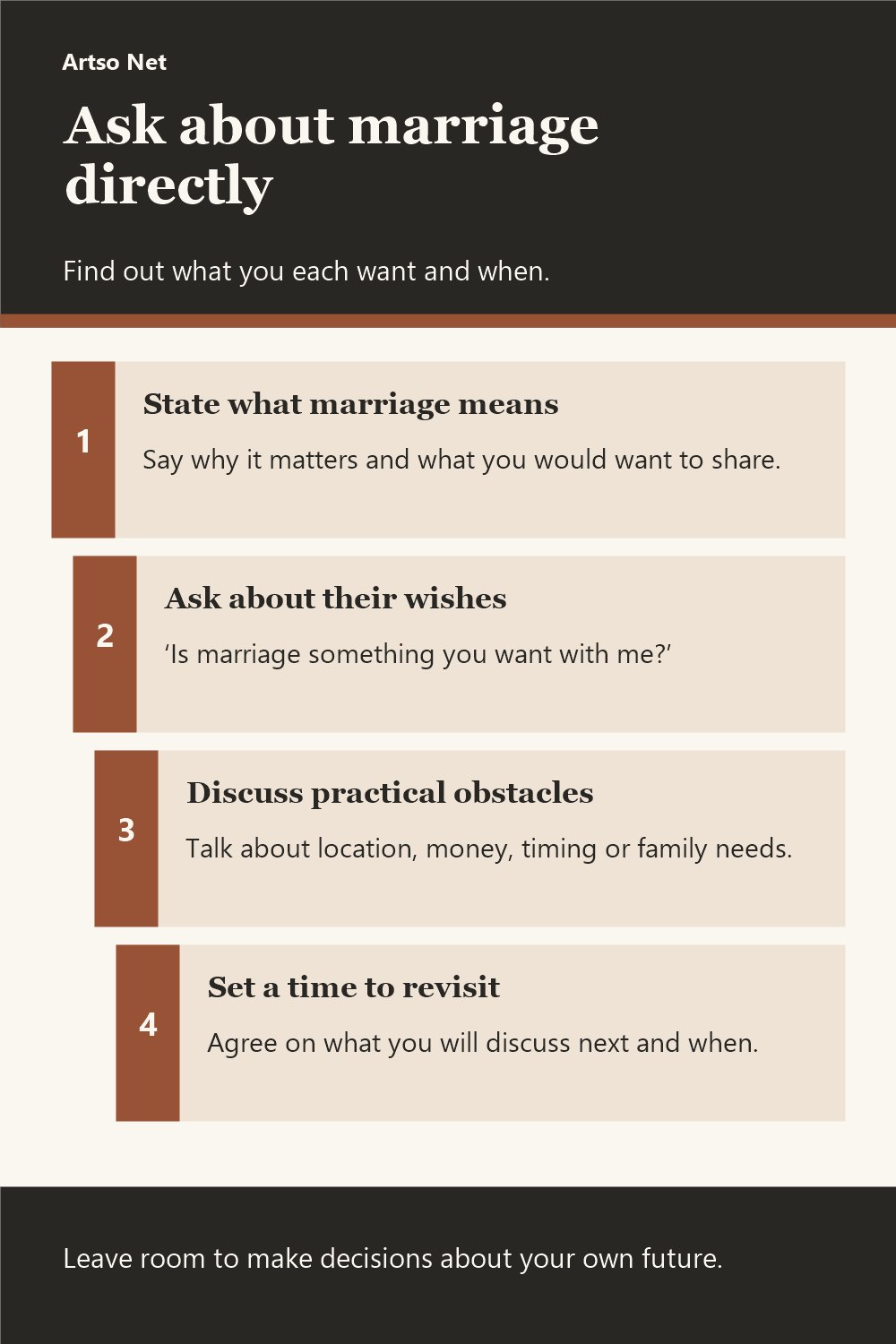
Read the infographic in text
Ask about marriage directly Find out what you each want and when.
- State what marriage means Say why it matters and what you would want to share.
- Ask about their wishes ‘Is marriage something you want with me?’
- Discuss practical obstacles Talk about location, money, timing or family needs.
- Set a time to revisit Agree on what you will discuss next and when.
Leave room to make decisions about your own future.