

You may feel strongly drawn to someone and still be unsure what you want with them. You might enjoy sex, want romantic closeness, value their company or hope for a committed partnership. Those wishes can overlap, and they do not always develop together.
There is no fixed sequence that every relationship follows from lust to lasting love. Rather than using a stage test, consider what you know about the person, how you treat one another and whether your wishes fit.
Name what you feel without rushing to a label
Try describing the feeling in ordinary language: “I look forward to seeing them,” “I enjoy being physically close,” or “I want to know more about their life.” Specific descriptions can be more useful than deciding immediately whether the connection qualifies as true love.
Strong excitement does not guarantee compatibility or commitment. A quieter feeling does not automatically mean the relationship lacks value.
You can take your feelings seriously while admitting what you do not yet know. You also do not have to develop romantic or sexual interest because someone seems suitable on paper.
Learn about the person beyond the attraction
Notice what you know from actual conversations and shared time. Can you describe their values, interests and current hopes, or are you filling in the gaps with what you imagine they might be like?
If you both want to, spend time in different ordinary settings: talking over a meal, taking a walk or doing an activity you enjoy. These are opportunities to learn about one another, rather than steps that are supposed to turn attraction into love.
A person may want a primarily sexual connection. That preference is not a moral failing, but it may differ from what you want. The important information comes from an honest discussion, not a prediction based on how many activities you share.
Notice everyday care and respect
Consider whether both people listen, follow through on agreements and make room for each other’s preferences. Can you raise a concern or decline something without being mocked, pressured or punished?
The National Domestic Violence Hotline’s guide to healthy relationships describes communication, respect and personal boundaries. Those qualities matter whatever label you give the connection.
Possessiveness, jealousy or demands for access are not proof of deeper love. You can enjoy closeness while keeping friendships, privacy and choices of your own.
Ask what relationship each of you wants
Feelings and agreements are different things. You may feel close without having agreed to exclusivity, and another person may enjoy your company without wanting a partnership.
Ask a direct question: “I am interested in exploring a relationship. What are you looking for?” Share your own position without presenting it as the only acceptable answer.
Take their current answer seriously. If they do not want the relationship you want, you can decide whether continuing would suit you. You do not have to keep dating while waiting for a more promising stage to arrive.
Keep consent and compatibility separate from intensity
A strong connection does not remove the need for consent or make every difference workable. You can feel attracted to someone while choosing not to have sex, move in, share money or make a long-term commitment.
Discuss the decisions that matter in your situation. You may have different preferences about time together, exclusivity, family involvement or future plans. The question is whether you can choose an arrangement that works for both people.
Neither an impressive romantic gesture nor a difficult conversation settles everything. Look at what is being agreed and how those agreements work in everyday life.
Allow room to learn and reconsider
You do not have to announce a lifelong conclusion after a few dates. You can be clear about what you want now and revisit the conversation when your feelings or circumstances change.
If uncertainty is difficult, ask what information would help you make your next decision. That might be clarity about exclusivity, more time together or an answer about a particular future plan.
You may choose to continue, slow down or end the connection. A useful next step respects both people’s choices rather than trying to manufacture a feeling or prove that the relationship has reached the correct stage.
Read the infographic in text
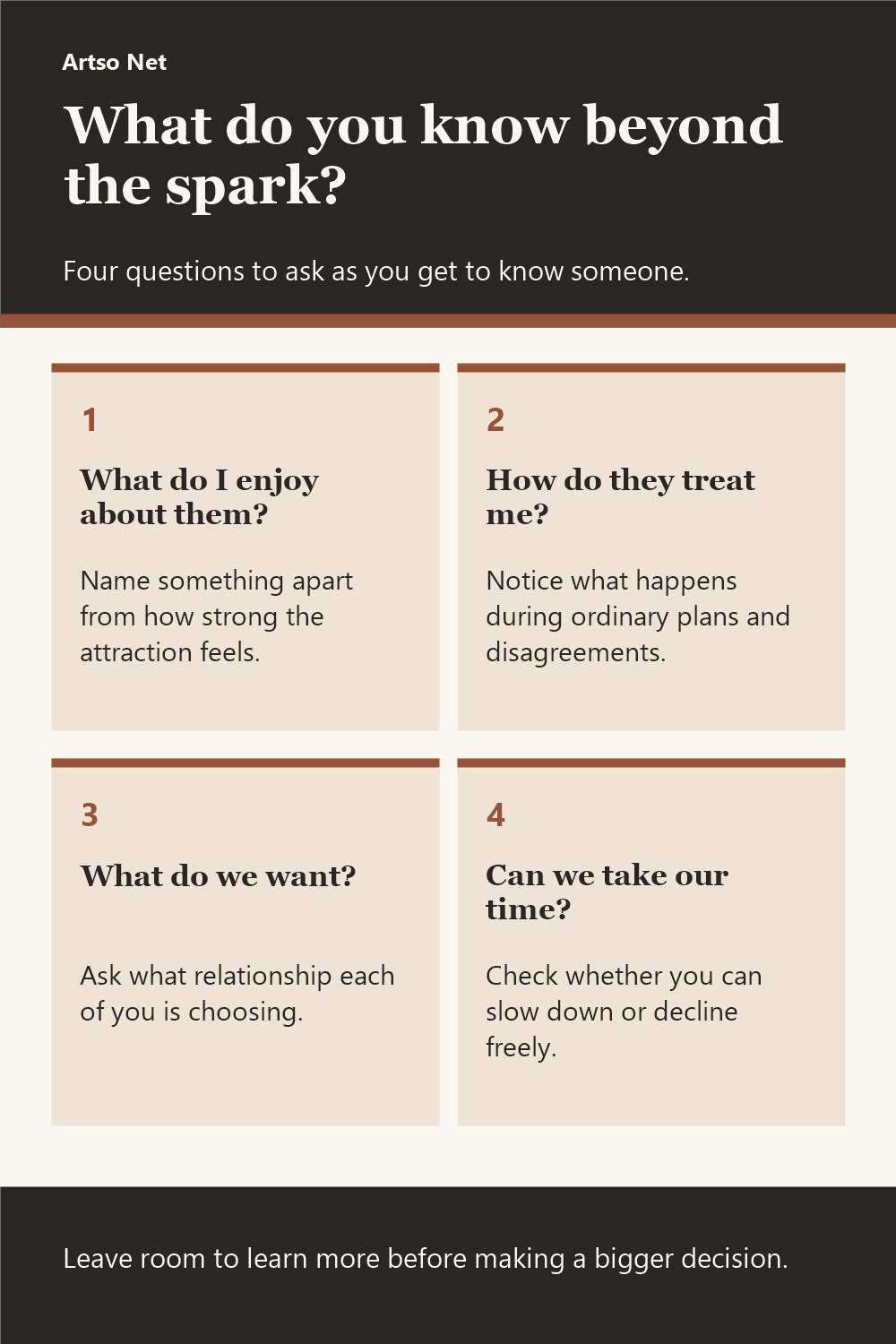
What do you know beyond the spark? Four questions to ask as you get to know someone.
- What do I enjoy about them? Name something apart from how strong the attraction feels.
- How do they treat me? Notice what happens during ordinary plans and disagreements.
- What do we want? Ask what relationship each of you is choosing.
- Can we take our time? Check whether you can slow down or decline freely.
Leave room to learn more before making a bigger decision.