

Feeling unloved can mean missing conversation, affection, consideration or practical support. You might feel overlooked by a partner, distant from a friend or alone despite being surrounded by people. The feeling deserves attention, even when its cause is unclear.
Begin with what you are experiencing and what you need. You do not have to prove that nobody cares about you, or decide that something is wrong with you, before asking for a change.
On this page
1. Name the kind of care you are missing
“I feel unloved” can contain several different needs. You may want someone to listen, share a responsibility, keep a promise, offer affection or make time for you. Try putting one need into words.
- Do I miss being asked how I am and having time to answer?
- Am I carrying work that leaves little room for companionship?
- Would I like more affection, or a different kind of contact?
- Is there someone with whom I can be honest without being mocked?
- Has a loss, move, illness or change in routine reduced my support?
Several needs may be present at once. Caring about yourself does not remove the need for other people, and receiving care does not require perfect confidence. You deserve consideration while you are still working out what would help.
2. Look at what happened before deciding what it means
Describe a recent situation in concrete terms. “Our plans were cancelled twice without arranging another time” gives you something to discuss. “I will never matter to anyone” extends that experience to your whole future.
A missed message alone does not explain someone’s feelings. Consider the wider pattern: how often contact happens, whether practical pressures have changed and what happens when you raise a concern. Context can help you understand a situation without requiring you to dismiss repeated neglect.
Different people may express care differently. That can be a useful topic for conversation, but it does not mean you must accept an arrangement in which your needs never receive attention. Ask about the mismatch rather than assuming a preferred style tells the whole story.
3. Ask for one change that someone can understand
If speaking feels safe, choose a suitable time and explain both the situation and your request. You could say, “I miss having a conversation that is not about chores. Could we set aside some time tomorrow to listen to each other?”
Another request might be practical: “I am too exhausted to enjoy our evenings. Can we divide these tasks differently?” Be clear about what would change and who would take part. Affection and help with responsibilities are different needs; one may not replace the other.
Invite an honest response. The other person may suggest a different time or explain a limit of their own. Look for an arrangement that considers both people rather than an agreement made only to end the conversation.
Our guide to building deeper connections offers further ideas for listening, sharing at your pace and noticing whether care can move both ways.
4. Make room for connection beyond one relationship
Consider where else you would welcome companionship or understanding. A friend, relative, community group or shared interest may offer a kind of connection that is currently missing. Choose a route that fits your access needs, time and resources.
The NHS guide to loneliness includes keeping in touch, sharing feelings and joining activities that interest you. You might start with a short call or one accessible group session. There is no requirement to build a busy social calendar.
Being around people does not automatically make you feel understood. Notice which conversations leave room for you to participate and whether the setting suits you. An activity that is unaffordable, inaccessible or uncomfortable needs adjusting or replacing.
Time alone can be welcome too. Enjoying a quiet activity does not cancel a wish for closeness, and finding something pleasant to do does not make you responsible for tolerating neglect.
5. Notice whether the response makes a difference
After discussing a need, look at what happens. Is there an effort to understand? Does an agreed change take place? Can a missed plan be acknowledged and rearranged? A caring response involves more than reassuring words in the moment.
One person may not be able to offer the relationship or contact you want. That can be painful information, but it gives you a basis for deciding where to put your time and what limits you need. You do not have to keep proving your worth through greater effort.
Repeated intimidation, insults or control require a different response from an ordinary mismatch. The US National Domestic Violence Hotline’s explanation of emotional abuse describes these patterns and ways to find support. If you fear someone’s response, seek appropriate private help before planning a confrontation; use a safer device if your activity may be monitored.
6. Ask for support when the feelings are hard to manage
Sadness and loneliness can have many causes. They are not proof that you failed to love yourself first, and you do not need to turn them into a personal diagnosis to ask for help.
The NHS guidance on low mood advises seeking help when you are struggling to cope, things you are trying are not helping or low mood persists. A qualified healthcare professional can help you explore what is happening. You can ask for support before the feeling becomes unbearable.
A trusted person may also help with a specific task: listening while you prepare a request, helping you find an accessible service or sharing time together. Tell them what would be useful when you can, and leave room to consider more than one source of support.
If the concern is mainly within your partnership, our guide to feeling lonely in a relationship explores shared plans and your choices. Your next step can be small, practical and based on the care you need now.
Read the infographic in text
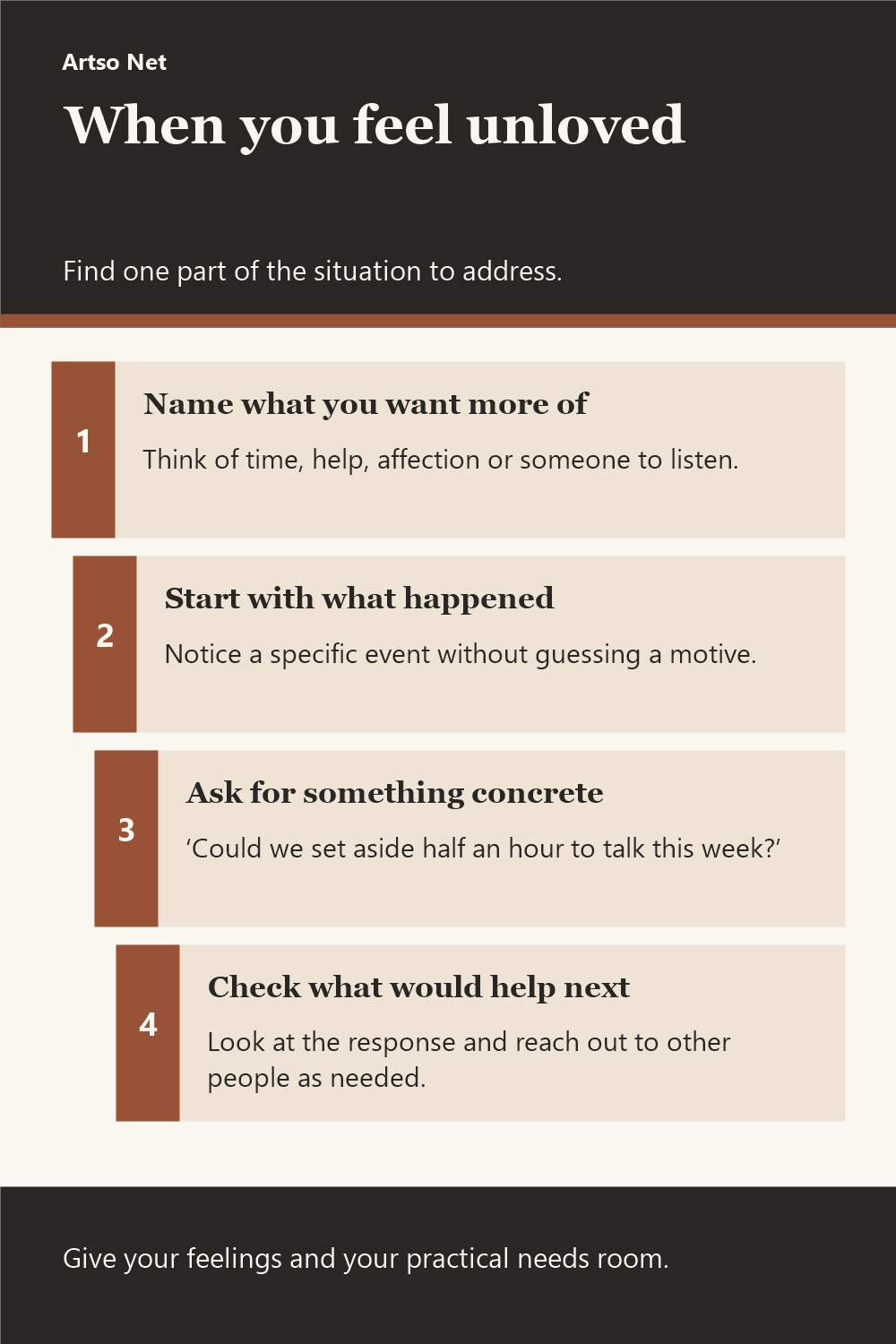
When you feel unloved Find one part of the situation to address.
- Name what you want more of Think of time, help, affection or someone to listen.
- Start with what happened Notice a specific event without guessing a motive.
- Ask for something concrete ‘Could we set aside half an hour to talk this week?’
- Check what would help next Look at the response and reach out to other people as needed.
Give your feelings and your practical needs room.