

When the same relationship problem keeps returning, it can be hard to know whether to try something different, ask for change or leave. Begin with the behaviour and its effect on your life rather than a label for yourself or your partner.
You can reflect on your own choices without accepting blame for someone else’s harmful actions. A disappointing relationship does not mean you are destined to be alone, and staying longer is not proof of greater commitment.
Describe the pattern in concrete terms
Choose one concern instead of writing a case against the whole relationship. What happens, how often does it happen and what follows when you raise it? “Plans are cancelled at the last minute most weekends” gives you something clearer to consider than “Nothing ever works.”
Notice what occurs afterwards. Is there an honest conversation, a workable adjustment and follow-through? Or do apologies repeatedly give way to the same behaviour without change?
If it is safe and useful, make a brief private note of the event, your response and the outcome. You do not need a perfect record to take your feelings or safety seriously.
Separate your responsibility from theirs
You are responsible for how you communicate, respect consent and respond to other people’s limits. Your partner is responsible for their own actions. Being imperfect does not make you responsible for being threatened, controlled or mistreated.
If you have avoided a difficult topic, you might choose to name it more clearly. That is different from believing that the right words could make another person become honest or stop causing harm.
Past experiences may affect what feels familiar or difficult. Exploring them with a qualified counsellor can help you understand your responses, without treating your history as an explanation that excuses someone else’s behaviour.
Make your relationship needs visible
Identify what you need in everyday terms: reliable plans, room for friendships, respectful disagreement, shared effort or agreement about commitment. Separate preferences you could negotiate from needs you cannot keep setting aside.
For example, different hobbies may leave room for compromise. Wanting children when your partner clearly does not may be a major incompatibility. Neither situation can be solved simply by trying harder to be attractive or agreeable.
The National Domestic Violence Hotline’s relationship spectrum distinguishes mutual respect and choice from unequal control. It can help you look at behaviour without needing to diagnose the person involved.
Ask for a change you can recognise
If discussion is safe, describe the behaviour, its effect and a realistic request. You might say: “When plans change without a message, I lose the evening I set aside. Can we let each other know as soon as we need to cancel?”
A useful agreement explains what each person will do. Notice whether the change appears in ordinary life, rather than relying only on a reassuring conversation.
You can choose when to review the situation, but there is no universal deadline or number of chances you owe someone. You are also allowed to decide that you no longer want the relationship.
Treat fear or control as a safety concern
Threats, sexual pressure, monitoring, isolation or restrictions on money and movement require more than a communication exercise. Do not assume that being more patient or explaining your needs perfectly will make the situation safe.
If you fear retaliation, you do not have to announce a boundary or ending in person. Consider private support from a specialist domestic-abuse service using a safer device if your activity may be monitored. The Hotline offers safety-planning guidance for people experiencing abuse, preparing to leave or living after separation.
Practical barriers such as housing, finances, disability or children can make decisions complicated. Needing help with those barriers does not mean you consent to the harm.
Choose support and a manageable next step
You do not have to settle the entire future today. Choose a next step that fits what you have noticed: clarify one expectation, seek individual support, explore practical options or spend time with someone you trust.
The NHS guidance on relationships and mental wellbeing encourages boundaries, personal time and support outside the relationship. Those connections can give you room to think without handing someone else the decision.
If you begin dating again, you can take your time and check how your preferences and limits are received. Reflection is useful when it helps you make choices; it should not become a requirement to make yourself perfect before you deserve care.
Read the infographic in text
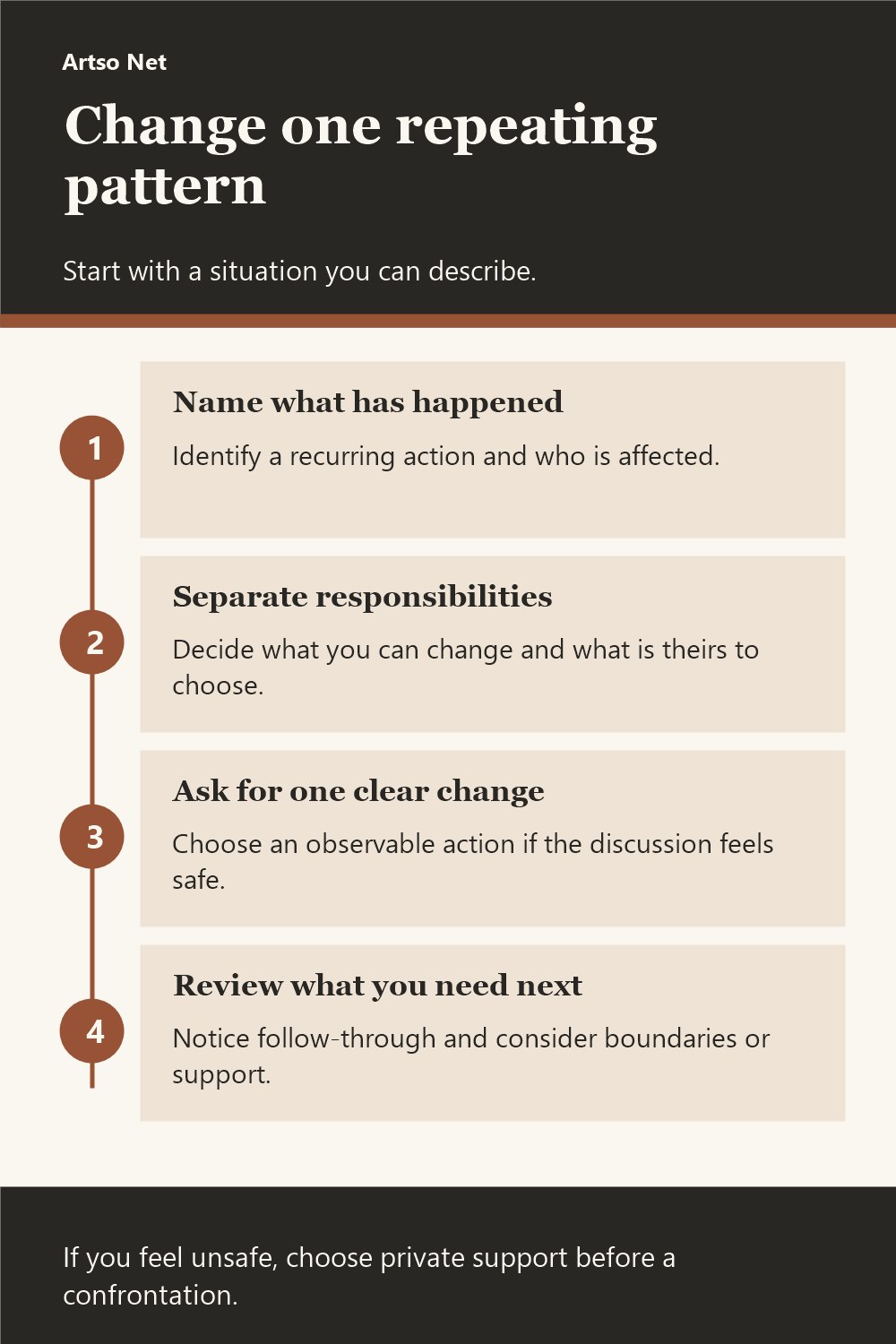
Change one repeating pattern Start with a situation you can describe.
- Name what has happened Identify a recurring action and who is affected.
- Separate responsibilities Decide what you can change and what is theirs to choose.
- Ask for one clear change Choose an observable action if the discussion feels safe.
- Review what you need next Notice follow-through and consider boundaries or support.
If you feel unsafe, choose private support before a confrontation.