

Frequent arguments do not measure how much a couple loves each other. A quiet relationship is not automatically distant, and a heated one is not automatically passionate or strong. Pay attention to how you are treated, whether you have room to disagree and what happens after the conversation.
If you are trying to understand a recent fight, separate three questions: what needed discussing, how each person behaved and whether anything useful changed. You can care deeply about a partner and still decide that a pattern of conflict is not workable for you.
On this page
Separate disagreement from proof of love
A disagreement may concern a practical arrangement, a different preference or a more serious incompatibility. Raising the issue can give both people information. The argument itself does not prove devotion, predict that you will stay together or make the relationship worth preserving at any cost.
Nor do you need to provoke a reaction to see whether someone cares. A partner who speaks quietly or asks for time may still take your concern seriously. Look for a response to the issue rather than a particular performance of anger, jealousy or distress.
Notice freedom, respect and safety
Consider whether each person can finish a thought, give a different answer or leave the discussion. Strong feelings can be present without insults or threats. The important distinction is what a person does and how that affects the other person’s freedom.
Love is respect’s conflict-resolution guide distinguishes ordinary disagreements from personal attacks and fear of retaliation. Being frightened to disagree deserves attention even if the relationship also includes affection or good days.
Threats, blocking an exit, breaking belongings or pressuring someone into sex do not become caring acts because they happen during an argument. You do not have to find perfect words to make another person responsible for their own behaviour. If you are afraid of the response, seek private support before arranging a confrontation.
Say what matters without setting a test
In a conversation that is safe to have, describe one issue and the effect it has on you. “When plans change without telling me, I cannot arrange my evening” gives the other person something specific to respond to. It is different from trying to establish that they never loved you.
You can express a difficult feeling without treating every accusation made in anger as your deepest truth. If you say something hurtful, take responsibility for that action rather than explaining that a fight revealed the “real you.” Honesty does not require cruelty or a test of how much pain a partner will tolerate.
Ask what you understood correctly and what remains different between you. You may discover a practical misunderstanding, or you may still want different things. Our guide to disagreements and workable next steps explores that conversation in more detail.
Take space without demanding a result
If the discussion becomes circular, consider a pause rather than increasing the intensity. In an otherwise safe relationship, you might say: “I need some time before I can listen properly. Can we return to the plan tomorrow?” Agree what is workable instead of requiring an immediate resolution.
A pause can make room for rest or reflection. It does not establish that either person has stopped caring, and it does not mean the issue is settled. Revisit what you were discussing when both people are willing and able; neither has to accept touch or apologise just to be allowed some space.
Keep repair and closeness freely chosen
After an argument, ask what needs repair. That might include acknowledging a hurtful remark, correcting a misunderstanding or changing an arrangement that repeatedly causes problems. “I called you a name. That was my choice, and I am sorry” is more specific than expecting affection to erase what happened.
Physical closeness can be welcome if both people want it. It is never owed as a consolation, proof of forgiveness or way to prevent another argument. RAINN’s consent guide explains that agreement must be voluntary and ongoing. A previous yes, a marriage or a reconciliation does not decide what someone wants now.
You can choose a hug, a quiet activity, more time apart or no physical contact. There is no required romantic ending to a difficult conversation. If you do reconnect affectionately, the original practical question may still need an answer.
Decide what the repeating pattern means for you
Look for specific changes over time. Are arrangements clearer? Are limits respected? Can you raise a concern without being punished? A warm apology matters less if the same harmful behaviour continues without accountability.
If discussions remain difficult but safe, you may want help from a qualified relationship professional or individual support while you decide what you need. If there is fear or control, seek advice from a specialist abuse service about your own circumstances rather than relying on a better conversation to fix the situation. In immediate danger, contact local emergency services when safe.
You do not need to rank your relationship against louder or quieter couples. Consider the effect on your everyday life and the choices actually available to you. Our guide to high-conflict patterns, boundaries and safety can help you look more closely at what has been happening.
Read the infographic in text
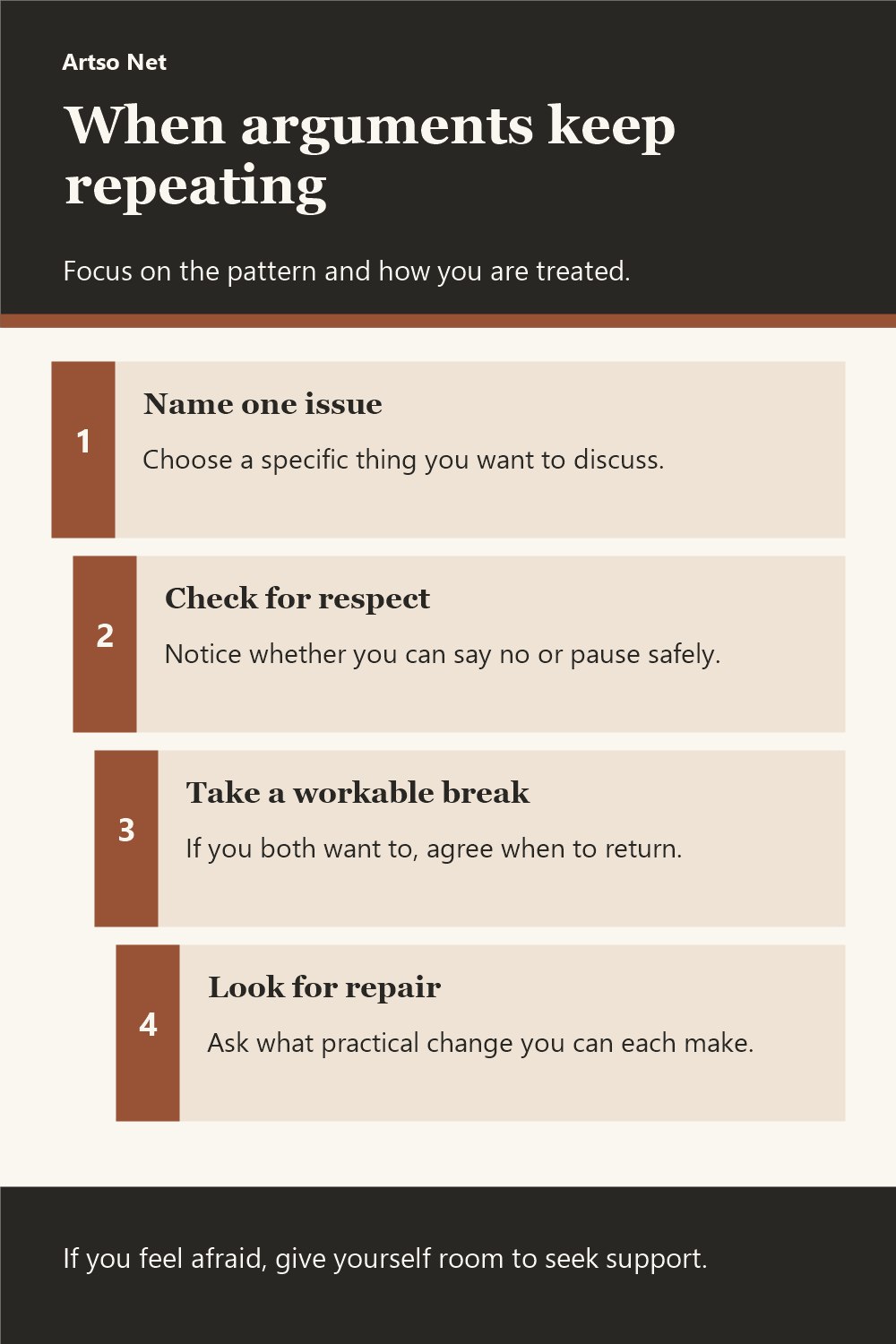
When arguments keep repeating Focus on the pattern and how you are treated.
- Name one issue Choose a specific thing you want to discuss.
- Check for respect Notice whether you can say no or pause safely.
- Take a workable break If you both want to, agree when to return.
- Look for repair Ask what practical change you can each make.
If you feel afraid, give yourself room to seek support.