

You may feel deeply connected to a partner and still have questions about the relationship. Feeling safe, handling disagreement respectfully and valuing one another are useful things to notice. They do not settle every question about compatibility or the future.
Consider how those qualities work in ordinary life. Can both people ask for what they need, make choices freely and follow through on what they agree? The questions below can help you reflect without requiring a perfect relationship or a certainty test.

Look at what helps you feel cared for
Think of a recent ordinary interaction. Did your partner listen when something mattered to you, respect a preference or offer the kind of support you actually wanted?
Care can look different for different people. One person may appreciate practical help, another affectionate time together or space to think. Ask rather than assuming that your preferred way of showing care is the only meaningful one.
Comfort matters alongside freedom. You should be able to decline an activity, keep a private conversation or spend time with other people without being threatened or punished.
Consider how you handle disagreement
Disagreement does not automatically mean a relationship lacks love. Notice whether you can discuss the issue without insults, intimidation or pressure to give in.
You may need a pause before returning to a difficult subject. Where it is safe, explain that you want to come back to it and agree a realistic time. A pause is more useful when it leaves room for the conversation rather than becoming a way to avoid it indefinitely.
Some differences can be accommodated and others affect whether the relationship works for you. A respectful discussion can help clarify that; it does not require both people to reach the same preference.
Accept the person while keeping your boundaries
You can appreciate a partner’s personality and differences without accepting every behaviour. Being loved does not require either person to abandon a value, tolerate repeated harm or become whatever the other person wants.
Separate a difference you can live with from an agreement that matters. Enjoying different hobbies is different from repeatedly breaking a promise about a shared responsibility.
Discuss changes that affect both of you. A request is something the other person can consider freely; a boundary describes what you will participate in and what choices you may make.
Notice follow-through and repair
Look at what happens after a promise or an apology. Does the person acknowledge the particular behaviour and make a practical effort to change it?
You can recognise a genuine effort while also noticing that a problem remains. Forgiveness, trust and continuing the relationship are separate choices, and none has to happen on a deadline.
Consider your own actions too. Can you acknowledge a mistake, listen to its effect and make a change you are able to sustain? Mutual care includes responsibility without making one person accountable for the other’s harmful behaviour.
Talk about the relationship you are choosing
Ask what commitment, privacy and a shared future mean to each of you. Meeting family, enjoying sex or spending a quiet weekend together may be meaningful without establishing every agreement.
You can rely on one another and still have interests, friendships and support of your own. A workable arrangement takes account of health, income, caring responsibilities and what each person can realistically offer.
If your wishes differ, name the difference. You may decide to adjust the arrangement or recognise that you want incompatible futures. Caring about someone does not require pretending that those questions are already settled.
Choose one useful conversation or next step
Try asking, “What helps each of us feel cared for?” and “What one change would make daily life together more respectful or manageable?” Choose a specific issue rather than trying to measure the entire relationship at once.
Notice whether the discussion leaves room for both people’s choices and whether an agreement is followed in practice. You can revisit it as circumstances change.
If there are threats, control or fear, seek individual support before raising plans that could put you at risk. The guide to controlling behaviour and safer next steps can help you consider support. A relationship’s meaning does not remove your right to safety or choice.
Read the infographic in text
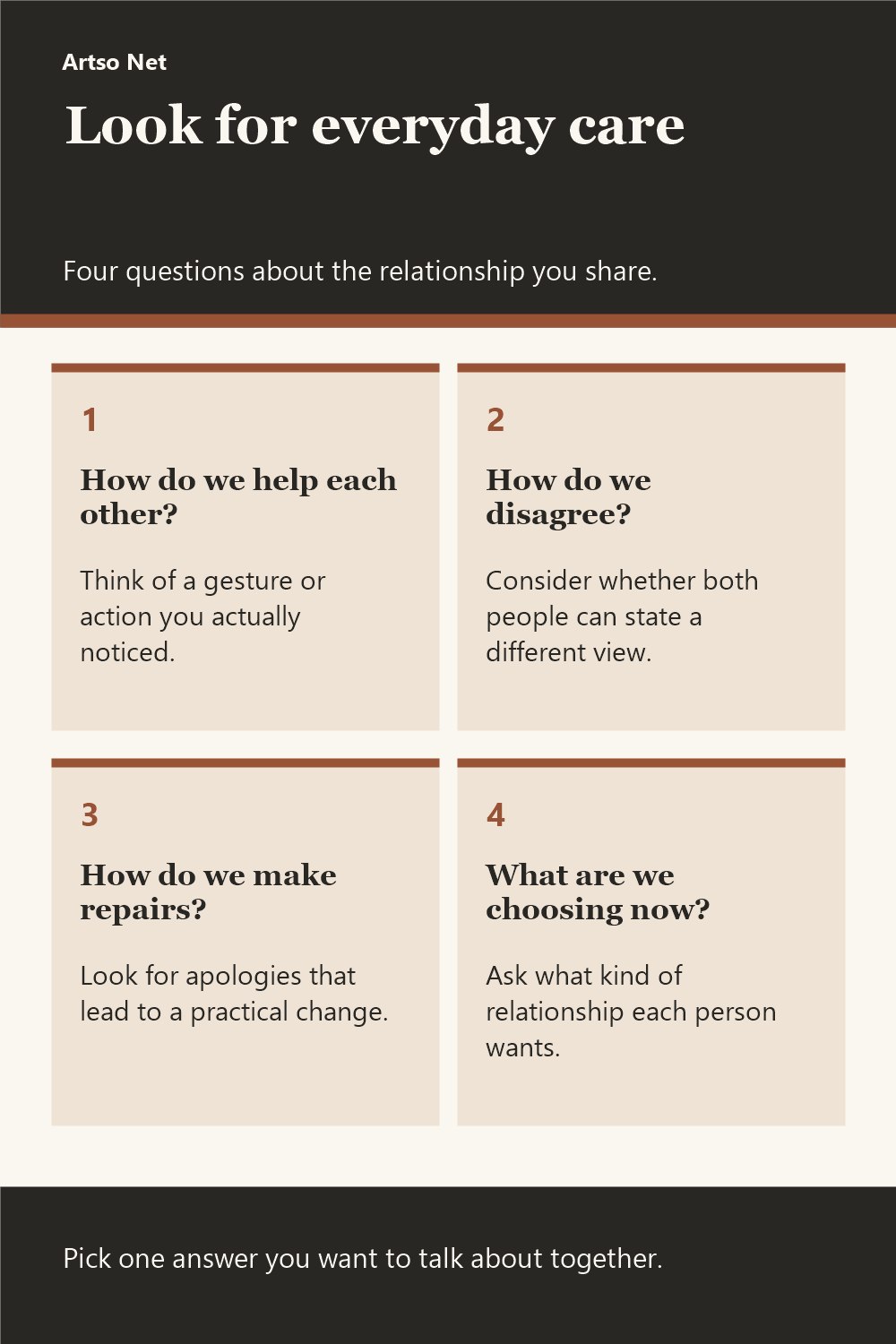
Look for everyday care Four questions about the relationship you share.
- How do we help each other? Think of a gesture or action you actually noticed.
- How do we disagree? Consider whether both people can state a different view.
- How do we make repairs? Look for apologies that lead to a practical change.
- What are we choosing now? Ask what kind of relationship each person wants.
Pick one answer you want to talk about together.