

Asking for time, affection or consideration is a reasonable part of a relationship. It does not mean you have failed to love yourself. The difficulty comes when repeated pursuit replaces a clear conversation, or when one person is expected to keep asking for an agreement that never becomes real.
You can express a need without trying to control another person’s answer. Their response then helps you decide whether the relationship available to you is one you want to continue.
Describe the need in concrete terms
Begin with what you notice and what would help. “Our plans often stay uncertain until the evening, and I find it hard to organise my week” is clearer than “You never care about me.” You can describe an effect without claiming to know the other person’s motives.
Distinguish a need from one particular solution. You may need more reliable time together; possible solutions could include a planned evening, a shorter meeting or earlier notice when plans change. Naming the need leaves room to discuss an arrangement that both people can keep.
If you are unsure what is missing, consider when you feel overlooked and what a more considerate response would look like.
Make a clear request that allows an honest answer
Try: “Could we decide our weekend plans by Thursday?” or, “I would like more affectionate time together. How does that feel to you?” Choose a moment when you can both pay attention rather than raising several concerns during an argument.
A request gives the other person room to agree, decline or suggest something different. Avoid testing them, threatening to withdraw affection or expecting them to work out an unspoken rule.
The Centre for Clinical Interventions’ assertiveness resources offer practical ways to express yourself while respecting another person’s rights.
Listen to the answer and consider both people’s needs
A partner may care about you and still be unable or unwilling to meet a particular request. Ask what is possible and what matters to them. Mutual consideration does not require identical preferences or an exact division of effort in every moment.
A clear refusal or an incompatible relationship goal needs to be taken seriously. Repeating the same request more intensely does not create mutual agreement. If the answer is uncertain, ask what remains open and whether there is a practical next step you both want to take.
You can understand someone’s reasons without deciding that the arrangement works for you.
Choose boundaries you can act on
A boundary describes your own choices. For example: “If we have not agreed a plan by Friday afternoon, I will make other arrangements.” It is most useful when it protects your time or wellbeing and is something you are prepared to follow through on.
Explain it plainly where that is safe and useful. You do not need to use distance, silence or jealousy as a lesson for the other person. You can take space because you need it, while being clear about what that means.
If you regularly abandon your own plans to remain available, start with one commitment you will keep for yourself.
Look for follow-through without treating a feeling as proof
Notice what happens after a conversation. Are agreed changes attempted? Can you discuss a setback without being dismissed? Does the arrangement become more workable, or does the same promise keep replacing action?
Your feelings matter and can prompt you to ask questions. Feeling strongly drawn to someone does not, by itself, establish that the relationship is respectful or compatible. Consider what you actually experience over time.
You do not need a perfect case against someone to decide that a relationship is not meeting an important need. Nor does one difficult conversation automatically determine the whole relationship.
Seek support and prioritise safety when needed
When both people want to work on a problem, another conversation or support from a qualified professional may be useful. You can also decide to stop pursuing an arrangement that leaves important needs repeatedly unmet.
Threats, intimidation, humiliation or pressure are different from an ordinary disagreement about time or affection. If raising a concern could put you at risk, prioritise support and a safe next step. The National Domestic Violence Hotline’s guide to healthy relationships explains respect, boundaries and equality.
You are allowed to want care and consideration. Expressing that clearly, listening to the response and making your own choices is a practical way to respect both yourself and the other person.
Read the infographic in text
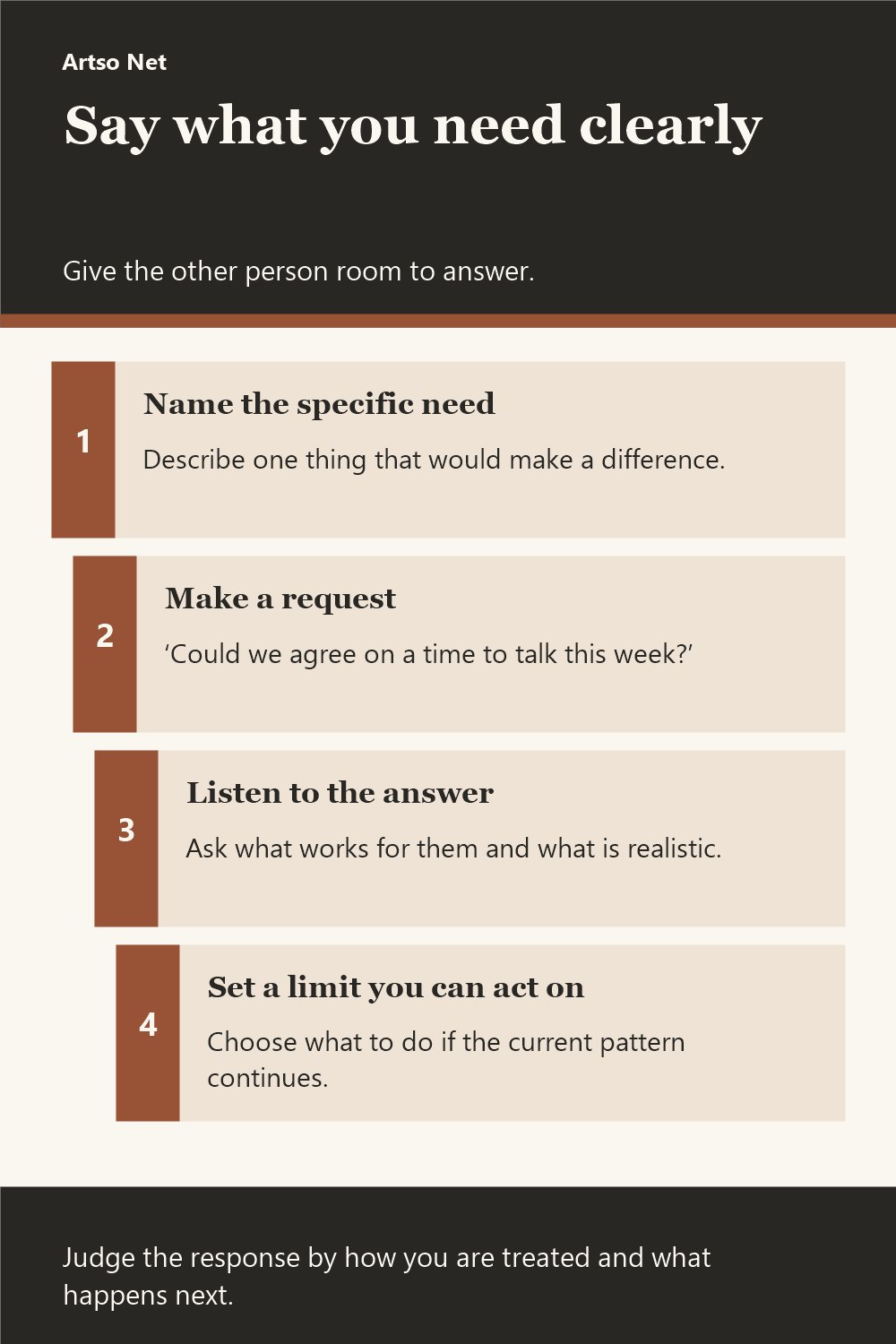
Say what you need clearly Give the other person room to answer.
- Name the specific need Describe one thing that would make a difference.
- Make a request ‘Could we agree on a time to talk this week?’
- Listen to the answer Ask what works for them and what is realistic.
- Set a limit you can act on Choose what to do if the current pattern continues.
Judge the response by how you are treated and what happens next.