

A message going unanswered can leave you wondering whether to check in, wait or move on. Silence alone does not tell you what someone feels or why they have not replied. The useful question is what you know, what communication you need and what you want to do next.
You can show interest without repeatedly chasing an answer. You can also decide that a pattern does not work for you without trying to make the other person jealous or teaching them a lesson.
Look at the context before deciding what it means
Think about your connection and the message itself. A conversation with a new match is different from an established relationship or a confirmed plan to meet. A message that did not ask a question may also leave different expectations from “Are we still meeting at six?”
Consider the usual pattern, any plans that need an answer and what you know about the person’s availability. A single delay does not establish disinterest, manipulation or a particular personality.
If you have a concrete reason to think someone is in immediate danger, seek appropriate local emergency help. More dating messages are not a substitute for responding to an actual safety concern.
Choose whether one clear follow-up would help
If contact is welcome and there has been no request to stop, one calm follow-up may be reasonable. You might write: “I enjoyed meeting you. Would you like to get together again?” For a practical plan, ask the practical question: “Are we still on for tonight? I need to decide what to do with my evening.”
Choose wording that says what you want to know. A long account of every possible reason for the silence can make the question harder to answer and leave you feeling more exposed.
You do not have to send another message. If you have already asked clearly, you can leave the decision there. Respect a no, a request for space or a request for no further contact.
Give yourself a plan instead of repeatedly checking
There is no universal number of minutes or days that proves someone cares. You can still decide how long you are willing to keep a particular plan open and what you will do if you do not hear back.
For example: “If I do not have confirmation before I need to leave, I will make other plans.” That is a decision about your time, rather than a deadline designed to force affection.
- Put notifications aside while doing something you want or need to do.
- Save an emotional message as a private note before deciding whether to send it.
- Avoid contacting them through several accounts, friends or workplaces to get around a lack of reply.
- Ask a friend for company rather than repeated analysis of read receipts.
Discuss expectations if the connection continues
If they respond and you want to keep seeing them, you can ask about the pattern directly. “I do not expect constant messages, but I would like us to confirm plans. What works for you?” gives both people something specific to discuss.
Listen to their answer and notice what happens afterwards. A different texting rhythm may be workable; repeated unconfirmed plans or unwanted pressure to be constantly available may not be.
The Centre for Clinical Interventions describes assertive communication as expressing your position clearly while respecting others. You can make your needs visible without controlling their response.
Leave jealousy and punishment out of the decision
Posting a date with someone else to provoke a reaction, delaying a reply as revenge or asking friends to report how happy you look may create more guessing. A reaction does not tell you whether you have compatible intentions or respectful communication.
If you decide to reply, do it because you want the conversation. If you decide to end contact, you can do that because the situation no longer fits, rather than as a test to make someone chase you.
Repeated silence used alongside threats, control or humiliation deserves more attention than an ordinary difference in texting habits. The Hotline’s relationship spectrum can help you consider the wider behaviour.
Choose a next step that respects both people
You may continue the conversation, clarify one expectation or stop investing in the connection. If a closing message is appropriate and safe, keep it direct: “I am looking for more consistent communication, so I am going to leave this here. Take care.” A closing message is optional, especially where contact is unwanted or unsafe.
Disappointment does not require you to prove that the other person is terrible or that you never liked them. Make room for your feelings and for the rest of your life.
Your next step can be a clear question, another plan for your evening or time with someone you trust. You do not need a perfect explanation of the silence to choose what works for you.
Read the infographic in text
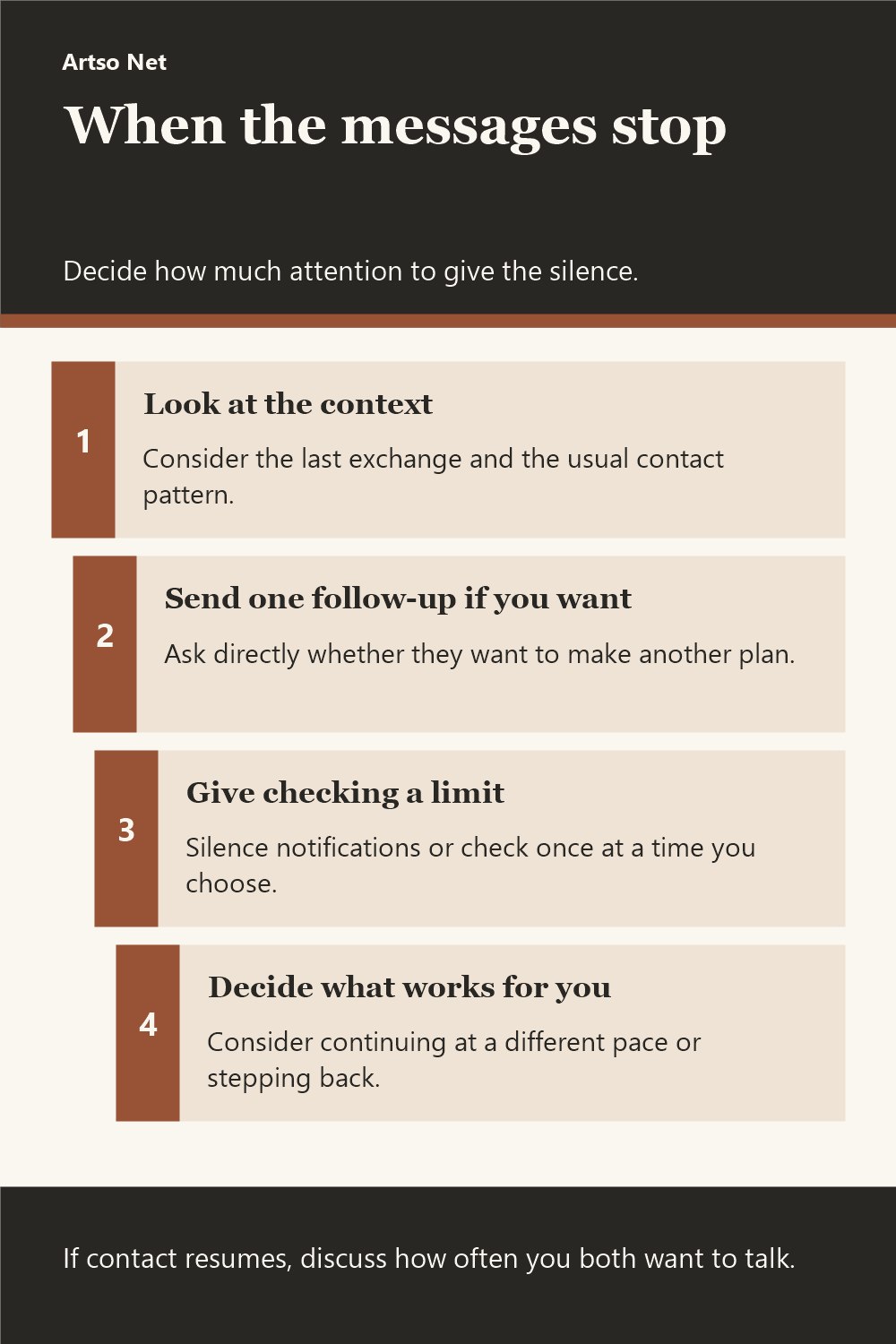
When the messages stop Decide how much attention to give the silence.
- Look at the context Consider the last exchange and the usual contact pattern.
- Send one follow-up if you want Ask directly whether they want to make another plan.
- Give checking a limit Silence notifications or check once at a time you choose.
- Decide what works for you Consider continuing at a different pace or stepping back.
If contact resumes, discuss how often you both want to talk.