

When people talk about unconditional love, they may mean steady care, acceptance or affection that is not withdrawn over every disagreement. Those wishes can be meaningful. They do not require you to accept any behaviour or promise to remain in a relationship regardless of what happens.
A more useful conversation than deciding whether your love is pure enough is asking how you want to treat each other. Care can include boundaries, honest disagreement and the freedom to leave.
On this page
Explain what unconditional means to you
You and your partner may use the same phrase differently. One person might mean, “I want reassurance that a difficult day will not end the relationship.” Another might hear, “You must stay with me whatever I do.” Talk about the expectations behind the words.
Try a concrete example: “If we disagree, I want us to be able to take a break without threatening to end things. I also need us to take harmful behaviour seriously.” A specific request is easier to discuss than a sweeping promise.
Family relationships differ too. There is no single parent-child experience that every reader shares, and a romantic partnership does not need to copy a particular idea of parental love.
Separate love from permission
You can love someone and decline sex, refuse to lend money, protect private information or decide not to live together. A boundary is not proof that your feelings are weak.
Equally, your partner can have limits you find disappointing. The question is whether you can discuss the difference with respect, rather than treating affection as a debt that buys agreement.
“I care about you, and I am not comfortable sharing my passwords” states both care and a limit. If someone responds with threats, monitoring or pressure, consider support from a trusted person or a specialist service. You do not need to keep negotiating to prove your love.
Respect the person and address the behaviour
You do not have to turn a psychological term into a rule for your relationship. Focus on what happens between you: can you name a hurtful action, hear each other’s perspective and discuss what needs to change?
For example, “When you mocked me in front of our friends, I felt embarrassed. Please do not make that joke again.” The response matters. An apology followed by a change offers different information from dismissing the concern or blaming you for raising it.
Respect does not mean giving someone all your attention or meeting every need. Both people can have friends, interests, private thoughts and sources of support outside the partnership.
Practise care through everyday choices
Choose actions you can reasonably offer. You might ask how a difficult appointment went, listen without immediately offering a solution or share responsibility for an ordinary task. Ask what would help rather than assuming you know.
Make room for disagreement. Caring partners can feel annoyed or need space. If a conversation becomes heated, agree on a pause and, where safe and appropriate, a time to return to it. Taking a break should not be used to punish someone or avoid every difficult subject.
The love is respect guide to boundaries and expectations offers further examples of discussing limits. No exercise can guarantee that two people will want the same relationship.
Keep room for change and choice
A relationship may need to change as health, work, responsibilities or preferences change. Revisit agreements instead of assuming that one conversation settles them forever. You can ask, “Does the way we handle this still work for both of us?”
There is no need to decide that love has disappeared before ending a relationship. A difference in goals, a limit you cannot accept or harmful treatment can be enough reason to step back.
You also do not have to feel perfectly confident or love every part of yourself before you can care for someone. Start with the choices available today: respect a refusal, make an honest request, repair what you can and seek support when you need it.
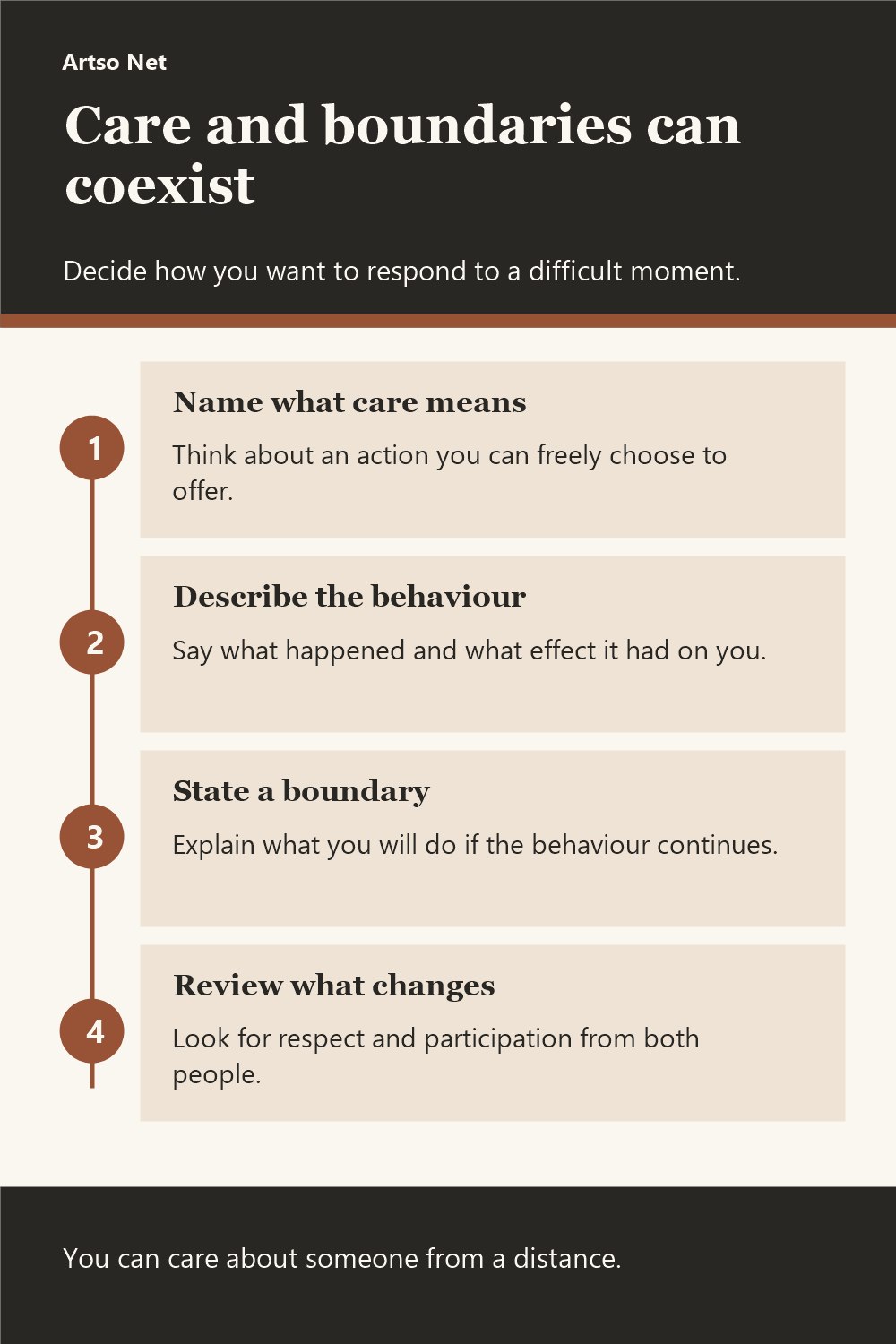
Read the infographic in text
Care and boundaries can coexist Decide how you want to respond to a difficult moment.
- Name what care means Think about an action you can freely choose to offer.
- Describe the behaviour Say what happened and what effect it had on you.
- State a boundary Explain what you will do if the behaviour continues.
- Review what changes Look for respect and participation from both people.
You can care about someone from a distance.